

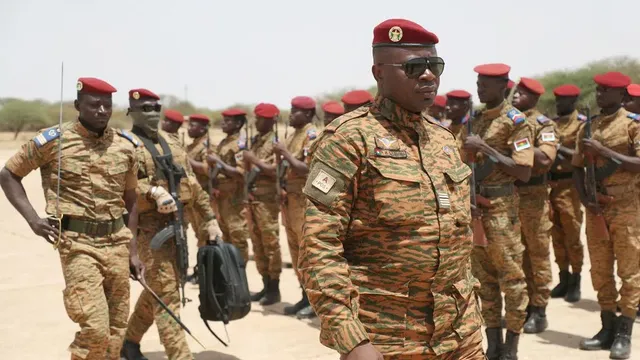
Togo extradites ex-Burkina Faso leader amid coup plot claims
Togo extradites ex-Burkina Faso leader amid coup plot claims
- Paul-Henri Sandaogo Damiba was arrested in Togo and extradited to Burkina Faso after being accused of attempting to destabilize the government.
- Damiba faces multiple charges including embezzlement and corruption, and was previously the leader following a coup in 2022.
- His extradition reflects ongoing instability and military involvement in West African politics.
Story
In January 2023, Togo made a significant geopolitical move by extraditing Paul-Henri Sandaogo Damiba to Burkina Faso, which occurred after a formal request from Burkina Faso's military junta. Damiba, who had been living in Togo since his ouster in September 2022, faced multiple allegations back home, including embezzlement of public funds and incitement to commit crimes. The decision to extradite came just days after Togolese authorities arrested him in Lome, and it was confirmed that assurance was provided that Damiba would not face the death penalty in Burkina Faso. Damiba rose to prominence in January 2022 when he led a coup against Burkina Faso's civilian government, amid rising violence perpetrated by Islamist militants. However, his tenure was undercut by ongoing attacks, leading to his removal in September by Ibrahim Traore. Post-coup, the Burkina Faso junta identified Damiba as being involved in a broader conspiracy with plans reported to implicate attempts on the current leader's life. Although specific links to coup plotting were not firmly established, Damiba had previously been warned about his perceived destabilizing actions. The extradition order highlighted the incidents surrounding military governments in West and Central Africa, as the region has witnessed multiple coups since 2020 fueled by escalating security crises. Damiba's case is emblematic of the region's political volatility, where military leaders have continuously justified their ascent to power through claims of restoring security amid a chaotic situation. With Damiba facing a series of serious charges, including theft and corruption, the political landscape in Burkina Faso remains tense as Traore’s regime consolidates power. Meanwhile, the ramifications of this extradition could further intensify tensions within Burkina Faso, challenging the new junta's grip on leadership as the country confronts its internal strife and external pressures from regional bodies like ECOWAS, which has been dealing with its own set of crises involving military takeovers.
Context
The impact of military coups in West Africa has been profound and far-reaching, affecting the political landscape, economic stability, and social cohesion of the region. Military coups often lead to the disruption of democratic governance, undermining electoral processes and violating human rights. The rise of coup d'états has notably increased in recent years, particularly in countries such as Mali, Burkina Faso, and Guinea. These events frequently occur against a backdrop of perceived state failure, including inadequate governance, corruption, and security challenges such as terrorism and civil unrest. The cyclical nature of coups means that their consequences are not just immediate, but can perpetuate a cycle of instability that is difficult to break. Economically, military coups tend to discourage foreign investment, leading to a decline in economic growth and worsening conditions for citizens. Investors often seek stability and predictability, which is compromised in the wake of such upheavals. The long-term economic ramifications can severely limit the ability of the population to access essential services, healthcare, and education. Additionally, countries recovering from coups may face sanctions, which further restrict economic interaction with global markets, exacerbating poverty and inequality among the populace. It creates an environment where economic recovery is slow and hindered, which can lead to social discontent and further unrest. Socially, military coups can fracture the fabric of society, deepening divisions along ethnic, religious, and political lines. The sudden and often violent nature of coups can lead to casualties, displacement, and loss of trust in institutions. Civil society organizations and opposition groups frequently face repression under military regimes, limiting freedom of expression and civic engagement. This suppression can cultivate an atmosphere of fear, where citizens feel powerless to challenge the status quo. Furthermore, the prioritization of security over social needs often leads to increased military presence in everyday life, contributing to a normalization of violence and instability in communities. In conclusion, the cumulative effects of military coups in West Africa are severe, impacting governance, economic progress, and societal cohesion. The trends suggest that without significant intervention and a commitment to democratic principles, countries in the region will continue to face challenges that perpetuate the cycle of coups. Addressing the root causes of discontent—such as governance failures and economic inequality—is crucial for establishing stability and fostering resilience against future coups. Sustainable development and a focus on human rights are essential not only for peace but also for helping to forge a more stable and prosperous future in West Africa.


