

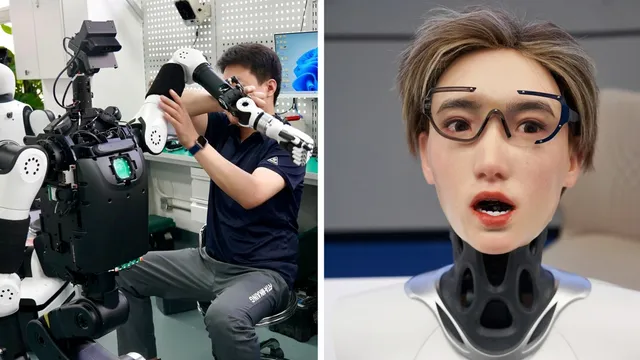
China advances humanoid robots to combat aging population crisis
China advances humanoid robots to combat aging population crisis
- Beijing has made significant investments in the robotics sector as part of its national strategy.
- Recent robotics events in Beijing demonstrated substantial advancements in technology and performance.
- The government envisions humanoid robots playing essential roles in caring for its aging population.
Story
In recent months, Beijing has prioritized the robotics industry as part of its national agenda, amid escalating competition with Washington in fields like artificial intelligence. The Chinese government has committed to focusing on cutting-edge science and technology in its five-year plan, including the development of humanoid robots tailored to meet the needs of an aging society. This urgency is reflected in a series of robotics events showcasing significant advancements, such as dramatic improvements in robot performance during public marathons, where more than a hundred robots participated, showcasing enhanced capabilities compared to previous years. Last year, a robotics marathon in Beijing highlighted the early developmental stage of such technologies, with only a limited number of robots completing the course. However, in the most recent marathon, one robot achieved a time that surpassed the human world record for a half-marathon, signaling substantial progress in robotics. These events are also supported by showcases on platforms like Chinese state broadcaster CCTV, where advanced robotic performances have become more commonplace. The presence of humanoid robots at public events represents an integral strategy to introduce technology that can assist in various tasks, specifically targeting care for the elderly and children. Unitree Robotics has recently unveiled a nearly 9-foot-tall humanoid robot designed to accommodate a human pilot, merging sci-fi concepts with practical robotic applications. This machine is notably the first of its kind and merges elements of traditional bipedal movement with the capability to operate as a quadruped. Such innovations exhibit the potential shift toward a future where robots play a more active role in society, although experts debate the practicality of humanoid structures for most tasks. The focus remains on improving the robots' software intelligence to facilitate more effective interactions and operations in various environments. As the competition in the robotics industry intensifies, major international figures such as Elon Musk have acknowledged these developments. Musk's remarks highlight the innovations emerging from China, which have implications for the broader technology landscape, particularly in the wake of previous international collaborations. Industry experts caution, however, caution against viewing humanoid robots merely as performance art, urging for an approach that emphasizes the underlying potential for societal benefit, particularly as the nation grapples with unprecedented demographic challenges arising from rapid aging.


