

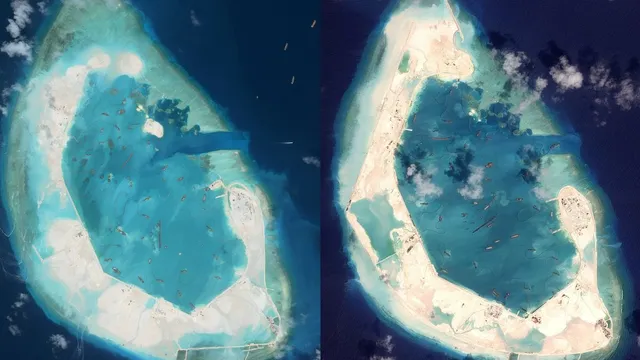
China expands its military reach with massive island reclamation in the South China Sea
China expands its military reach with massive island reclamation in the South China Sea
- China's reclamation efforts at Antelope Reef have resulted in an increase of approximately 1,490 acres since late 2023.
- This expansion is part of a broader pattern of territorial assertiveness in the South China Sea against overlapping claims from neighboring countries.
- The developments signal China's intent to fortify its military presence in disputed waters, raising tensions with Vietnam.
Story
In late 2023, China accelerated its land reclamation activities at Antelope Reef, a submerged coral formation in the Paracel Islands located 250 miles east of Vietnam and 175 miles southeast of Hainan Province. Satellite imagery from January 2024 indicated that approximately 1,490 acres had been reclaimed, significantly increasing Beijing's footprint in disputed waters and offering potential support for military infrastructure. This expansion follows China's history of asserting control over the Paracel Islands, which it seized from South Vietnam in 1974 and has since fortified with various military features. Analysts at the Center for Strategic and International Studies noted that the newly constructed areas at Antelope Reef could accommodate sophisticated military installations, including coastal defense systems and an airstrip long enough to support military aircraft. This development comes amid rising tensions between China and Vietnam, as Vietnam has also been enhancing its own military capabilities in the Spratly Islands. The reclamation efforts signal to Hanoi that China is determined to expand its maritime claims despite ongoing territorial disputes. In response to China's reclamation activities, the Vietnamese government issued a formal objection, although their protests have been relatively restrained in recent years to maintain stable relations with China. On its part, China's Foreign Ministry has defended the reclamation as necessary for improving living conditions and the local economy, asserting its claim over the Paracels as inherent territory. This situation illustrates a broader pattern of geopolitical maneuvering in the South China Sea, where multiple nations are engaged in overlapping claims of sovereignty. China's actions underscore its commitment to projecting power in the region while competing with the influence of the United States and its allies. As military tensions rise, Beijing's insistence on avoiding spheres of influence suggests a strategic goal of consolidating its position economically while minimizing foreign military presence. This intricate dynamic not only defines China's regional ambitions but also reshapes the balance of power in Southeast Asia.
Context
The South China Sea has been a contentious area for territorial claims, particularly involving China, due to its strategic importance and rich maritime resources. China's claims are historically rooted, dating back several centuries, with references to various historical maps and treaties that the government asserts support its sovereignty over the vast majority of this sea. The expansive territories claimed include not only the Spratly Islands and Paracel Islands but also significant portions of the sea itself, often demarcated by the so-called "nine-dash line." This line, first officially published in 1947, has become a symbol of China's assertive stance in the region, arguing historical rights to these waters based on old maritime practices and historical documents. However, this claim has faced challenges and counterclaims from several neighboring countries, including Vietnam, the Philippines, Malaysia, and Brunei, all of whom have presented their own historical and legal arguments to justify their respective claims to parts of the South China Sea. Internationally, the South China Sea dispute is complicated further by the absence of a universally accepted framework for resolving such territorial conflicts. The United Nations Convention on the Law of the Sea (UNCLOS), established in 1982, provides guidelines for national entitlements over maritime areas, yet it has seen differing interpretations and applications by the claimant states. In 2016, a significant ruling by the Permanent Court of Arbitration concluded that China’s claims based on the nine-dash line have no legal basis under international law. This ruling was a pivotal moment in the dispute, affirming the Philippines' rights to parts of the sea, but China rejected the ruling and continued to enhance its presence in the area through island-building initiatives and military expansions, further escalating tensions with other Southeast Asian nations and the United States. The geopolitical ramifications of China's territorial claims in the South China Sea are profound. The region is not only a crucial trade route, but it also holds vast reserves of oil and natural gas, making it a focal point for energy security and economic interests among regional and global powers. The ongoing tensions have led to increased military activity in the area as the United States, in particular, conducts Freedom of Navigation Operations (FONOPs) to challenge China's broad claims and ensure open maritime passage. In response, China has beefed up its military capabilities, constructing artificial islands equipped with airstrips and military infrastructure, thus solidifying its position despite international pushback. As of March 2026, the situation remains dynamic and unpredictable. The territorial claims in the South China Sea showcase not only the historical legacies that influence modern-day geopolitics but also the complexities of international law in resolving such longstanding disputes. With regional nations closely monitoring China's activities and potential responses from the U.S. and its allies, the balance of power and stability in the South China Sea appears as precarious as ever, underscoring the necessity for diplomatic dialogue and conflict resolution efforts among all stakeholders involved.


