

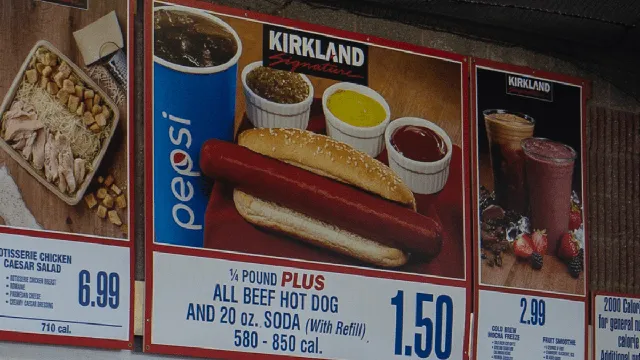
Costco's hot dog price will remain unchanged forever, promises CEO
Costco's hot dog price will remain unchanged forever, promises CEO
- Ron Vachris confirmed that the price of the hot dog and soda combo will not change.
- The $1.50 price has been in effect since 1985, highlighting Costco's commitment to consumer value.
- This pricing strategy has gained significance in today's economically challenging environment.
Story
In a recent Instagram video, Ron Vachris, the President and CEO of Costco, assured customers that the price of the popular $1.50 hot dog and soda combo would remain unchanged. This price has been in place since 1985, symbolizing Costco's commitment to providing value despite rising costs due to inflation and economic pressures faced by consumers. Vachris highlighted that the price is intentionally set at break-even to foster goodwill among customers. This iconic deal is viewed as a crucial selling point amidst rising food prices, especially in light of the K-shaped economic recovery that has widened the gap between different income groups in the United States. Historically, Costco's executives have maintained that the affordability of the hot dog combo reflects the company's philosophy of prioritizing customer satisfaction over short-term profits. Renowned for this approach, former CEO Craig Jelinek famously vowed to keep the price from increasing, emphasizing the hot dog as a customer staple and a symbol of the brand's identity. As the U.S. economy faces challenges, including high costs of living and a struggling lower-income demographic, Costco's hot dog pricing has gained significance as a beacon of stability nationwide. Affordability in the food industry has shifted alongside the current economic climate, with food companies recognizing the need for value-oriented offerings. Several fast-food chains have responded to the K-shaped economy by launching new value menu options aimed at customers feeling financial strain. Costco’s commitment to its long-standing hot dog offer helps distinguish it as a leader among retailers committed to supporting consumers within their budget constraints. This steadfast policy allows customers to rely on pricing that hasn’t budged for over three decades, reinforcing Costco's market position during these turbulent times. The ongoing commitment reflected in the no-change policy on the hot dog pricing aligns with broader trends in retail where businesses are attempting to engage and retain consumers facing tightening budgets. With its successful hot dog combo, Costco sets a standard for affordable dining experiences, as many consumers now seek dependable prices in a marketplace where increasing costs have become the norm. The messaging around the hot dog's constant pricing serves not only as a marketing tactic but also as a testament to Costco's values as it navigates the current economic landscape.
Context
The K-shaped economy concept describes a divergent economic recovery following a downturn, where different sectors or demographics experience varying rates of growth. This uneven recovery creates a 'K' shape when visualized graphically, with one arm of the 'K' representing sectors that are thriving while the other arm reflects those that are lagging behind. As economies recover from recessions or crises, such as the one prompted by the COVID-19 pandemic, disparities can emerge that exacerbate existing inequalities. During the initial phases of the pandemic, for instance, essential sectors such as technology and e-commerce flourished due to a shift in consumer behavior, while hospitality, travel, and brick-and-mortar retail struggled immensely. This recovery pattern poses challenges for policymakers who must address the needs of those left behind as others succeed. The K-shaped recovery often highlights systemic inequalities present in an economy. High-income individuals and families may continue to accumulate wealth through investments in stock markets that quickly recover, while low-income workers employed in sectors hit hardest may face persistent job losses and declining incomes. The disparity in access to technology and remote work opportunities further compounds these differences. For example, while many knowledge workers adapted seamlessly to remote work, millions of service workers had to face furloughs or permanent job losses, causing a significant gap in economic resilience among different worker classifications. Policymakers and economic analysts must remain vigilant to the potential long-term consequences of a K-shaped recovery. Inequality can lead to weakened consumer spending, which is a critical driver of economic growth. As the gap widens between those who are benefitting from the recovery and those who are not, the overall economic system becomes fragile. The repercussions may result in diminished social cohesion and increased political unrest as frustration mounts among groups that perceive themselves to be left behind. Therefore, it is essential for governments to craft targeted policies that not only stimulate growth in sluggish sectors but also address structural inequities. This might include strengthening social safety nets, providing additional support for affected industries, and investing in workforce development to enable displaced workers to transition into growing fields. In conclusion, understanding the dynamics of a K-shaped economy is crucial for navigating recovery after significant economic downturns. While some sectors may thrive, it is imperative that concerted efforts are made to lift those left behind to promote sustainability and inclusiveness in the economic landscape. This requires ongoing analysis and intervention from both public and private sectors to ensure that growth benefits all citizens rather than just a select few. By implementing equitable policies and fostering an environment where all individuals can succeed, we can work towards an economic future that is not divided by a K-shaped pattern, but rather a more unified and robust growth model.


