

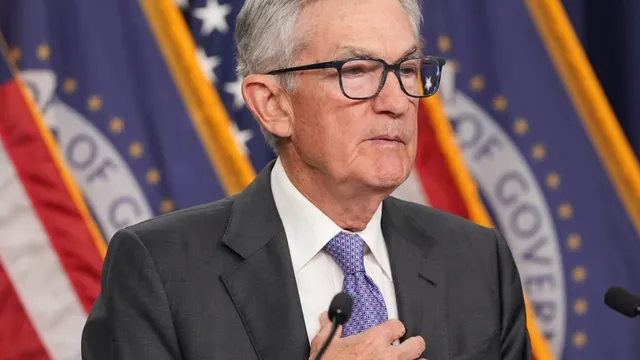
Donald Trump demands deeper Fed rate cuts to promote growth
Donald Trump demands deeper Fed rate cuts to promote growth
- The Federal Reserve recently lowered interest rates to a near three-year low of 3.6 percent.
- Trump criticized the Fed for not implementing deeper cuts to foster economic growth.
- The Fed's cautious stance may complicate future monetary policy amid political pressure.
Story
In the United States on December 10, 2025, President Donald Trump expressed dissatisfaction with the Federal Reserve's decision to lower the benchmark interest rate to 3.6 percent, characterizing it as a minimal adjustment that does not meet his expectations for stimulating economic growth. The Federal Reserve, facing pressures from both inflationary concerns and a sluggish job market, indicated a cautious approach in its monetary policy. This recent rate cut marked the third consecutive reduction, suggesting that the central bank is managing the delicate balance between supporting economic expansion while controlling inflation. Trump's criticism highlights an ongoing tension as the Fed signals a potential pause in further cuts, which may contradict his demand for more aggressive monetary easing in light of the current economic conditions. The labor market's reduction in momentum, coupled with existing inflationary pressures, complicates the Fed's decision-making. Although the central bank projected only one additional rate cut in 2026, Trump's administration appears to be gearing up for a significant shift in leadership at the Fed, potentially amplifying his influence on future monetary policies. Such developments could upend the Fed’s traditional stance and fuel market speculation regarding its independence amid increased political pressure. Investors reacted cautiously, observing these dynamics as they assess future economic performance. Overall, the economic landscape remains uncertain, influenced by the Fed's decisions, Trump's policies, and the evolving job market situation.
Context
The Federal Reserve's dual mandate is a pivotal framework guiding U.S. monetary policy, articulated in the Full Employment and Balanced Growth Act of 1978. This mandate stipulates that the Federal Reserve, often referred to as the Fed, is tasked with two primary objectives: promoting maximum employment and ensuring stable prices. The dual nature of this mandate underscores the delicate balance between fostering economic growth and controlling inflation, both of which are critical for a healthy economy. The Fed employs various tools of monetary policy, including open market operations, the discount rate, and reserve requirements, to achieve these objectives. Promoting maximum employment involves aiming for an unemployment rate that reflects the lowest sustainable level without triggering inflation. This is known as the non-accelerating inflation rate of unemployment (NAIRU). The Fed analyzes labor market indicators, including job creation, unemployment claims, and wage growth, to gauge the state of the economy and adjust its policies accordingly. On the other hand, achieving price stability is focused on managing inflation levels, typically targeted at around 2% based on the Personal Consumption Expenditures (PCE) index. This target aims to preserve the purchasing power of the dollar and safeguard savings while providing a predictable environment for investment. The interplay between these two objectives can create tension, especially during times of economic distress. For instance, in the aftermath of the 2008 financial crisis, the Fed implemented expansive monetary policies—such as lowering interest rates and employing quantitative easing—to combat rising unemployment and invigorate economic activity. However, such measures also raised concerns about future inflation. The Fed's challenge lies in striking the right balance, where stimulating economic growth does not lead to excessive inflation. Consequently, policymakers must remain vigilant and responsive to economic indicators that signal shifts in labor market conditions or price stability. Overall, the Fed's dual mandate has profound implications not only for the U.S. economy but also for global economic conditions. As the Fed navigates its mandates, its policy decisions can influence interest rates, investment flows, and financial markets worldwide. In a globally interconnected economy, the Fed's actions can have ripple effects, affecting exchange rates and economic growth in other nations. Therefore, adherence to this dual mandate requires a careful, nuanced approach, accounting not only for domestic economic conditions but also for international dynamics.


