

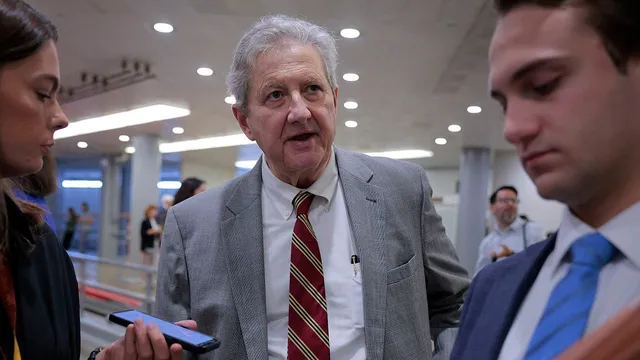
Senator Kennedy warns Ayatollah Khamenei seeks to kill Americans
Senator Kennedy warns Ayatollah Khamenei seeks to kill Americans
- Senator John Kennedy accused Ayatollah Ali Khamenei of wanting to kill Americans.
- Tensions between the U.S. and Iran have escalated due to Iran's nuclear ambitions.
- There is a need for careful negotiation protocols if a deal is reached with Iran.
Story
In the escalating tensions between the U.S. and Iran, Senator John Kennedy of Louisiana has voiced severe concerns regarding Ayatollah Ali Khamenei's intentions. He stated during a Senate floor discussion that Khamenei's goal is not only to oppress those who disagree with his ideology but also to kill Americans and others who do not support his jihadist agenda. Kennedy emphasized the urgency of the matter as U.S.-Iran relations remain strained, primarily due to Iran's nuclear ambitions. He believes the U.S. needs to be cautious in negotiations with Iran and ensure that any agreement has rigorous enforcement protocols. The backdrop to these statements involves a broader discourse on Iran’s military capabilities, particularly its nuclear program. President Donald Trump has previously articulated a hardline stance, indicating a willingness to take military action if a satisfactory nuclear agreement is not reached within a specific time frame. Trump's approach stems from ongoing worries that a nuclear-armed Iran would further destabilize the region, posing threats not just to Israel and neighboring countries but also to American interests. Recent developments raised speculation about Khamenei's safety following targeted military actions by Israel and the U.S. in Iran. Reports suggest that Khamenei may have been moved to a secure location amid these tensions, causing unrest and speculations among Iranian citizens about his whereabouts. Analysts observe that the military strikes have expanded the scope of U.S. objectives in the region beyond just nuclear containment, fitting into a larger narrative seeking regime change in Iran. The U.S. stance appears to be calling for the Iranian populace to rise against their government as Trump implied that the Iranian people should “take over your government.” Both American and Iranian officials are now contemplating the possible consequences of further military engagement. There is growing acknowledgment among lawmakers that any potential military action should involve Congressional approval. Amid these rising tensions, the realm of warfare and politics intertwines, posing a complex dilemma for both the U.S. administration and Iranian leadership. The situation remains fraught with uncertainty as it develops, highlighting the fragile nature of peace in the Middle East regarding Iran’s ambitions and the responses they evoke internationally.


