

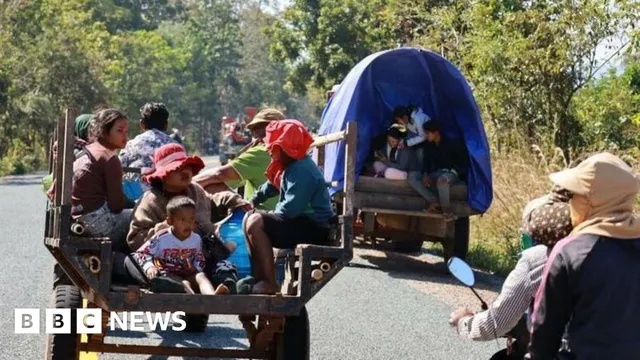
Violent clashes kill five amid escalating tensions at Thai-Cambodian border
Violent clashes kill five amid escalating tensions at Thai-Cambodian border
- Fresh clashes erupted along the Thai-Cambodian border on December 7, 2025, resulting in at least five fatalities.
- Both nations accuse each other of provoking the violence as thousands evacuate amid increasing tensions.
- The situation raises concerns over the safety of civilians, particularly children, who have faced significant educational disruptions.
Story
On December 7, 2025, civil unrest erupted along the border between Thailand and Cambodia, leading to the deaths of at least five individuals. The resurgence of violence marked the most severe confrontation since both nations agreed to a ceasefire in July. Each nation has blamed the other for initiating the conflict, causing significant panic among local residents. Thousands of individuals rushed to evacuate from their communities, highlighting the deteriorating security situation in the area. The Thai government, through Prime Minister Anutin Charnvirakul, expressed regret over the violence, stating that it aims to maintain peace but will take all necessary measures to protect its sovereignty. Conversely, Cambodia's former leader, Hun Sen, accused Thai forces of being the aggressors, calling them 'invaders' and justifying the retaliatory actions that followed. Amidst this back-and-forth, children, who have faced disruption in their education, have been particularly affected, with nearly 650 schools in Thailand closing their doors in light of the escalating tensions. Reports indicate that prior to these recent clashes, both nations had experienced intermittent tension since a ceasefire was brokered in July 2025. This ceasefire was a significant effort towards solving ongoing border disputes stemming from territorial claims that have persisted for over a century. The border conflict has previously disrupted examinations for local students, leading to heightened emotional distress in the community. Videos shared on social media have depicted schoolchildren fleeing their classrooms, emphasizing the distressing impact of the situation on the younger population. Following the latest outbreak of violence, there are calls for renewed diplomatic efforts and a return to dialogue. Both governments must prioritize the safety of their citizens, particularly vulnerable populations like children, in order to end the cycle of violence that continues to plague their relations. The international community is observing the situation closely, as a return to conflict between these two nations could have broader implications for regional stability in Southeast Asia.
Context
The history of Thai-Cambodian border disputes is a complex interplay of historical, cultural, and political factors that have evolved over centuries. The border crisis primarily revolves around a series of territorial claims, which have roots in both ancient and colonial times. Significant among these is the area surrounding the Preah Vihear Temple, a UNESCO World Heritage site, which has been the focal point of multiple conflicts. The temple, originally built in the Khmer Empire in the 11th century, has established cultural significance for both Thailand and Cambodia, leading to longstanding disputes regarding its sovereignty. The modern phase of disputes intensified following the colonial era, particularly in the 20th century. After the fall of French colonial rule in Indochina, both nations inherited a complex array of boundaries that were not clearly delineated in many cases. This ambiguity was further complicated by nationalistic sentiments and political shifts within both countries. The International Court of Justice (ICJ) intervened in 1962, ruling that the temple belonged to Cambodia; however, this decision did not settle the broader territorial disputes. Tensions remained high, flaring up again in 2008 when Cambodia sought to list Preah Vihear as a World Heritage site, aggravating nationalist sentiments in Thailand and resulting in military confrontations. The border dispute has significant socio-political implications, impacting domestic politics in both countries. In Thailand, national identity and pride are heavily tied to territorial integrity, leading political leaders to often adopt hardline positions. Conversely, in Cambodia, territorial claims against Thailand are leveraged as a means to bolster national unity and distract from internal issues. Consequently, the dispute has always been intertwined with local politics, as leaders in both countries utilize nationalist rhetoric to gain popular support or to shift attention from domestic challenges. Public demonstrations, media portrayals, and political statements have been instrumental in reviving or suppressing tensions over the years. In recent years, there have been efforts towards negotiation and cooperation aimed at reducing conflict and enhancing bilateral relations. Initiatives involving dialogues and people-to-people exchanges have been proposed to foster mutual understanding. However, underlying issues remain unaddressed, and periodic flare-ups continue to underscore the fragility of peace in the region. Thus, the future of Thai-Cambodian relations and the resolution of the border dispute lie in the balance, dependent on the willingness of both nations to engage in constructive dialogue and find a lasting solution that acknowledges the historical claims while fostering cooperation for mutual benefit.


