

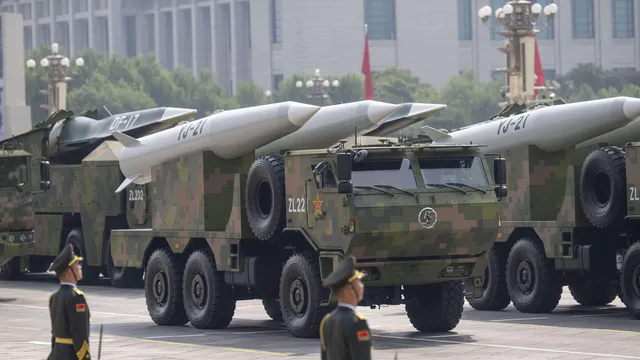
China boosts military spending amid growing tensions with the US
China boosts military spending amid growing tensions with the US
- China's military budget increased to $336 billion in 2025, marking a 7% rise.
- The U.S. plans to enhance its missile defense capabilities through the costly Golden Dome project.
- The escalating military expenditure poses significant implications for future U.S.-China relations.
Story
China has significantly increased its military spending in 2025, marking the 31st consecutive year of annual growth. The country’s military expenditure rose by over 7 percent, reaching $336 billion, which, while notable, accounts for just over a third of the United States' total defense budget. U.S. defense companies face pressure to replenish stockpiles drained by ongoing support to Ukraine, as demand for defense supplies continues to rise. Amid these developments, the U.S. military's focus is shifting towards developing advanced systems like the 'Golden Dome' to counter next-generation threats from China, North Korea, and Russia. The Trump administration has articulated a clear need for a new defense strategy, proposing an ambitious $1.2 trillion project aimed at intercepting fast-moving ballistic and hypersonic missiles. The plan for the 'Golden Dome' involves a network of sensors, trackers, and interceptors that will protect the U.S. mainland including Alaska and Hawaii, with ongoing discussions about including Canada under this defense umbrella. However, the Congressional Budget Office’s estimate suggests an exorbitant cost well beyond initial projections, complicating the funding consideration amidst demands for increased defense budgets. Over recent years, military dynamics have been shifting, especially with China ramping up its missile stockpile to over 3,100 ballistic missiles. The heightened pace of missile production and military spending by China has prompted the United States to reconsider its arms strategy in the Asia-Pacific region, particularly regarding Taiwan. Washington continues to provide substantial military support to Taiwan despite Beijing’s strong opposition and claim over the territory. The ongoing tensions play a crucial role in shaping U.S. defense policy as officials express their intent to maintain arms sales to Taiwan, affirming commitments made through Congressional legislation. As the international landscape evolves, both military powers are recalibrating responses to perceived threats. The U.S. emphasizes the need for advanced defenses against modern warfare techniques emerging from nations like China and North Korea. The atmosphere remains charged as both countries work towards strengthening their military postures, leading to speculation about potential future conflicts shaped largely by armament levels and technological capabilities. These developments underscore the importance of strategic military planning and the fiscal implications surrounding defense spending in the context of global stability.
Context
The impact of U.S. military spending on international relations is profound and multifaceted, influencing global power dynamics, contributing to geopolitical tensions, and affecting alliances. The United States has historically been the world's largest military spender, allocating substantial resources each year to maintain and enhance its military capabilities. This spending not only reflects the country's military priorities but also shapes its foreign policy and strategic interactions with other nations. For instance, high military expenditure can be viewed as a deterrent against adversaries, projecting power and stability, which can effectively deter aggression from rival nations. However, this also raises the stakes in international relations, as it can provoke countermeasures from other countries, leading to an arms race or heightened tensions, particularly in regions where power balances are delicate, such as East Asia and Eastern Europe. Moreover, U.S. military spending plays a crucial role in forging and maintaining strategic alliances. Many countries rely on U.S. military aid, which often comes with conditions that align allied nations' foreign policies with U.S. interests. This aid can enhance the military capabilities of allies, promoting stability in certain regions, but it can also lead to dependencies that complicate these nations' diplomatic autonomy. Furthermore, the U.S. military presence in various countries, justified by its defense spending, can strengthen alliances in theory; however, it may also result in local resentment and backlash against perceived imperialism, complicating the U.S.'s relations with some nations and their populations. On the global stage, the ramifications of U.S. military spending extend to multilateral organizations and treaties. The U.S. is often a significant participant in international defense discussions and agreements, reinforcing its influence over global security norms. However, its military spending can also undermine collective security efforts by fostering a unilateral approach to military engagement, which may be viewed by other nations as undermining global governance structures. Additionally, the way U.S. spending is perceived internationally can lead to differing reactions, with some countries viewing it as a protective measure for global stability and others seeing it as a threat to their sovereignty. Finally, the interplay between military spending and international relations is further complicated by domestic politics, where decisions on military budgets often reflect not just external threats but also internal political agendas. The military-industrial complex in the U.S. plays a significant role in lobbying for defense spending, which can prioritize military solutions over diplomatic ones. As global challenges evolve, such as cybersecurity, climate change, and transnational terrorism, the effectiveness of high military spending as a primary strategy for maintaining international peace and security is increasingly debated. Thus, while U.S. military spending is designed to secure national interests and project power abroad, it remains a double-edged sword that can generate both alliances and adversarial relationships, shaping the complex landscape of international relations.


