

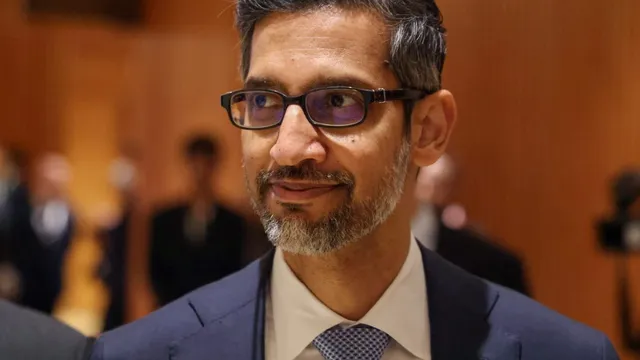
Sundar Pichai's $692 million pay package hinges on Waymo and Wing's success
Sundar Pichai's $692 million pay package hinges on Waymo and Wing's success
- Alphabet CEO Sundar Pichai is awarded a $692 million compensation package dependent on Waymo and Wing's performance.
- Waymo has recently secured $16 billion in funding to expand its operation to more international cities.
- Pichai's leadership will be crucial for the success of Alphabet's ambitious projects as they currently operate at a loss.
Story
On March 4, 2026, Alphabet announced a significant prospective compensation package for its CEO, Sundar Pichai, totaling $692 million over the next three years. This substantial package is heavily reliant on the performance of two of Alphabet's ambitious ventures, Waymo, the autonomous driving service, and Wing, which provides drone delivery services. Both companies are classified under Alphabet's 'Other Bets,' which collectively reported losses of $7.5 billion in 2025, indicating the financial challenges these moonshot projects face. According to regulatory filings, Pichai stands to gain approximately $260 million from Waymo and $90 million from Wing based on the companies’ performance and valuation increases over the specified period. This situation underscores the intense pressure on Pichai to drive these projects towards profitability, as they continue to operate at a loss, reflecting the inherent risks associated with investing in new technologies. Despite these challenges, Waymo made headlines in February 2026 by securing $16 billion in funding, primarily from Alphabet itself, lifting its valuation to an impressive $126 billion. This funding aims to expand Waymo's services beyond its current operational cities in California, Arizona, Georgia, Texas, and Florida, targeting international expansion into cities like London and Tokyo. However, the company is grappling with various challenges, including public safety incidents, like a Waymo vehicle blocking an ambulance in Austin, which not only raises operational concerns but could also affect public perception and regulatory approval for future expansions. Efforts to deploy Waymo services outside New York City faced resistance from labor groups and taxi drivers, further complicating its growth trajectory. Likewise, Wing, which has been operational since its spin-off from Alphabet’s Moonshot Factory in 2018, is not without its hurdles. The company has made strides in last-mile delivery services, partnering with Walmart to deliver goods from stores, and plans to increase its reach to over 270 Walmart locations by 2027. However, much like Waymo, Wing's operational effectiveness and profitability remain uncertain, serving as another focal point for Pichai's leadership evaluation. The complexity of overseeing these two ambitious projects highlights Pichai’s critical role in guiding Alphabet’s innovation strategy during a period of intense competition and scrutiny within the tech industry. In terms of additional compensation, Pichai is eligible for performance stock units worth up to $252 million, tied to Alphabet's shareholder returns compared to S&P 100 companies. He can also earn $84 million in Alphabet restricted stock units, maintaining his annual base salary at $2 million, unchanged since 2020. This remarkable compensation package represents a staggering 34,500% increase, an illustrative shift as Alphabet seeks to align its leadership incentives with long-term investment in emerging technologies. While Pichai's leadership is crucial during this transitional phase, the outcome of Waymo and Wing will ultimately determine the real value of this package and Pichai's legacy as CEO of Alphabet.


