

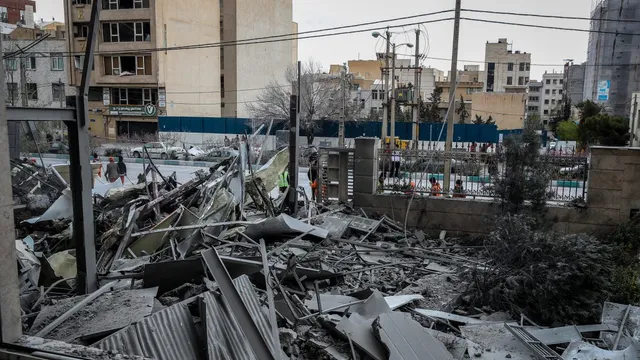
Iran faces significant attacks on nuclear facilities amid rising tensions
Iran faces significant attacks on nuclear facilities amid rising tensions
- Iranian military installations, including key nuclear facilities, have been struck as tensions rise between Iran, Israel, and the US.
- The Israeli military claims it targeted various Iranian missile production capabilities and nuclear program remnants.
- The ongoing military actions are leading to significant regional instability, with promises of retaliation from Iranian officials.
Story
In a series of escalating military actions, Iran has suffered significant attacks targeting its nuclear facilities, specifically the Shahid Khondab Heavy Water Complex in Arak and the Ardakan yellowcake production plant located in Yazd Province. These attacks, reported by Iran's Atomic Energy Organization, are seen as a critical blow to Iran's nuclear program, disrupting raw material processes required for uranium enrichment. As tensions rise, Iranian officials have made strong statements promising retaliation against any aggressors, indicating that the response to these strikes will be beyond the principle of 'an eye for an eye'. The backdrop to these military tensions includes ongoing negotiations for a ceasefire mediated by the United States, with President Trump advocating for a diplomatic solution while also increasing military pressure. Diplomatic efforts reportedly focused on a fifteen-point action list delivered to Iranian officials to foster a possible ceasefire, but these initiatives are complicated by the recent military strikes, which Iran claims contradict the diplomatic overtures made by the U.S. The geopolitical situation continues to shift, making room for escalated military confrontations that can severely impact regional stability. In response to the Israeli military's airstrikes, which targeted not only nuclear sites but also missile production capabilities, Israel's Defense Minister has warned that Iran will incur severe consequences for what he has described as a war crime. This message has sparked fears of a broader conflict, given the direct involvement of foreign powers like the U.S., which has indicated support for Israel. The recent airstrikes have prompted military readiness across the region, with various nations bracing for potential retaliatory measures from Iran. With ongoing military operations, life in the affected areas has been drastically impacted. The death toll has climbed significantly, with thousands reported killed in the ensuing conflict, exacerbating humanitarian crises across Iran and neighboring Lebanon. The disrupted operations in the Strait of Hormuz due to this conflict have further complicated global oil and commodities markets, leading to soaring prices and threatening international supply chains. The unfolding events underscore the fragility of the situation, as minor miscalculations could result in unintended escalation towards a broader conflict.
Context
Current US-Iran diplomatic relations have been characterized by a tumultuous history and evolving dynamics, particularly over the past two decades. Since the 1979 Iranian Revolution, which resulted in the Islamic Republic's establishment and severed ties with the United States, relations have oscillated between hostility and attempts at engagement. Key events, such as the Iran-Iraq War in the 1980s, the U.S. intervention in Iraq in 2003, and the nuclear program discussions, have significantly influenced these relations. The controversial nuclear deal, known as the Joint Comprehensive Plan of Action (JCPOA), finalized in 2015 under President Obama, represented a notable thaw in relations, aiming to curtail Iran's nuclear capabilities in exchange for sanctions relief. However, this progress was challenged by the Trump administration's unilateral withdrawal from the agreement in 2018, which reinstated harsh economic sanctions on Iran, escalating tensions once more. This shift fostered an environment of mistrust and animosity, leading to military confrontations in the region and a series of attacks attributed to Iranian-backed militias against U.S. interests in the Middle East. As of March 2026, the diplomatic landscape remains highly complex and fluid. The Biden administration has signaled a willingness to restore diplomatic engagement with Iran, emphasizing a desire to negotiate a revised nuclear agreement. Despite the initial optimism surrounding potential talks, progress has been sluggish, impacted by numerous factors, including regional security concerns, Iran’s continued missile development, and its support for proxy groups in countries such as Iraq and Lebanon. Furthermore, the Gulf states' apprehensions, particularly from Saudi Arabia and Israel, over Iran's regional ambitions have complicated the negotiation process, with those nations demanding a more comprehensive approach that addresses not just the nuclear issue but Iran's broader influence in the region. The Iranian perspective remains rooted in the belief that sanctions relief is paramount for any negotiations to succeed, and the government seeks assurances of U.S. commitment to lifting sanctions before trusting the process. Meanwhile, domestic politics in both nations influence the diplomatic dance; hardliners in Iran may resist concessions tied to sanctions, while in the U.S., bipartisan skepticism regarding Iran persists, complicating the Biden administration's ability to navigate talk of re-engagement. These factors contribute to a continuing standoff, albeit with some avenues of dialogue remaining open, as both sides are aware of the potential for conflict should diplomacy fail. The strategic calculus of both nations is further influenced by changing geopolitical dynamics, including relations with China and Russia, as these powers increasingly play roles in the region. Looking ahead, the future of U.S.-Iran relations hinges on both nations' political will to engage and compromise amidst challenging domestic and international pressures. Building a sustainable diplomatic framework will require addressing not only the nuclear legacy but also enhancing regional security, mutual recognition of sovereignty, and respect for national interests. Analysts believe that a new diplomatic approach that includes regional partners and acknowledges the concerns of all stakeholders may lead to more fruitful discussions. However, history has shown that optimism must be tempered with caution, given the entrenched positions and deep-seated grievances that have long defined U.S.-Iranian relations.


