

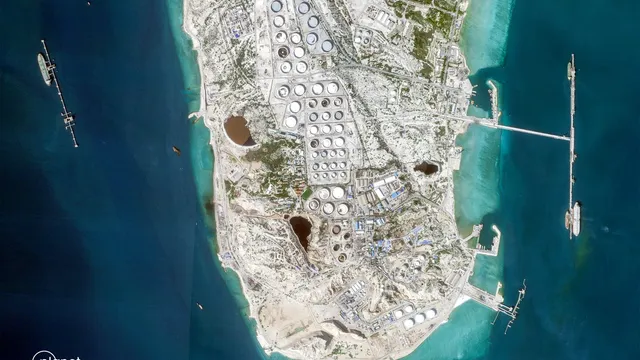
Trump announces powerful strikes on Iran's military at Kharg Island
Trump announces powerful strikes on Iran's military at Kharg Island
- On March 13, 2026, U.S. military forces conducted significant strikes on military targets on Kharg Island, a critical hub for Iran's oil economy.
- President Donald Trump announced that while military targets were obliterated, the island's oil infrastructure was spared for now, citing reasons of decency.
- Tensions in the region are escalated as Iran threatened retaliatory actions against U.S. allies if their energy facilities are attacked.
Story
On March 13, 2026, a significant military operation took place involving the United States targeting Iran's Kharg Island, a vital oil export hub located approximately 15 miles off the Iranian coast. The attack was part of an ongoing conflict marked by rising tensions in the Strait of Hormuz, where Iran has been accused of interfering with shipping. President Donald Trump declared that U.S. forces had conducted one of the most powerful bombing raids in Middle Eastern history, obliterating military installations but refraining from destroying the island's oil infrastructure for reasons he described as 'decency'. However, he warned that this could change if Iranian actions threatened the free passage of ships through the strait, an essential waterway for global oil transport. Following the U.S. military's strikes, Iranian military leaders issued stern warnings, stating that any assault on their energy infrastructure would lead to retaliation against the oil facilities of U.S. allies. In Trump's statement, he emphasized the importance of maintaining safe maritime operations and the possibility of more extensive military action if Iran persists with threats or attacks. He notably hinted at the long-term strategy surrounding Iraq and Iran, indicating that the U.S. military presence could involve significant reinforcements likely aimed at securing oil routes and deterring hostile actions. As international attention turns towards Kharg Island due to its crucial role in Iran's economic stability and the shipping of a large portion of the country's oil exports, experts are closely monitoring the escalating rhetoric from both sides. Growing military deployments from the U.S., including thousands of troops and naval assets, suggest a strategic shift aimed at containing Iranian influence and securing the region. The potential implications of the strikes and the Iranian response could affect oil prices and geopolitical stability in the Middle East for the foreseeable future, as Kharg Island remains a linchpin in global oil markets. In this context, the Iranian leadership's aggressive posture towards perceived threats from the U.S. indicates that further conflict is likely. Trump's decision to spare the oil infrastructure at this point, viewed as a strategic calculation, reflects a careful balancing act to avoid further escalation while maintaining pressure on Iran. As tensions continue to grow, the situation remains fluid, with potential for significant developments that could reshape the dynamics of U.S.-Iran relations and oil market stability.
Context
The bombing of Kharg Island, a strategically vital oil export hub for Iran, has had significant repercussions on the nation's economy. This incident has not only disrupted the export of oil, which is a critical source of revenue for Iran, but has also destabilized the already fragile economic conditions prevailing in the country. Given that oil exports contribute considerably to Iran's GDP and government budget, any interruption can lead to immediate fiscal challenges. The bombing heightened concerns over security and operational capabilities, resulting in a decrease in investor confidence, thereby deterring foreign investment that could have aided economic recovery initiatives. Following the bombing, immediate sanctions and response measures from the international community further exacerbated Iran's economic situation. With sanctions already limiting trade options, the destruction on Kharg Island made it increasingly difficult for Iran to maintain its oil output levels, leading to reduced revenue streams. The Iranian rial faced devaluation against major currencies, increasing inflation (( affecting the purchasing power of citizens who are already grappling with economic hardships. Small businesses, vital for employment and local economies, started to suffer due to decreased demand and rising costs of imported goods. In addition to the direct financial impact, the bombing has had indirect consequences on Iran's economy. Increased military spending to enhance security and protect critical infrastructure diverts funds away from essential social services and public welfare programs. This strain on resources may contribute to social unrest as citizens express dissatisfaction with diminishing living conditions. Additionally, the strategic importance of Kharg Island means that its stability is crucial for broader geopolitical relations, influencing Iran's negotiations and partnerships within the region and beyond. Overall, the bombing of Kharg Island can be viewed as a significant shock to Iran's economy, compounding existing vulnerabilities and challenging the nation's ability to navigate an already complex economic landscape. As the Iranian government seeks to stabilize the economy, the long-term effects of this incident will depend on its capacity to secure its vital infrastructure, rebuild investor trust, and possibly re-engage with the international community to relieve some of the economic pressures faced.


