

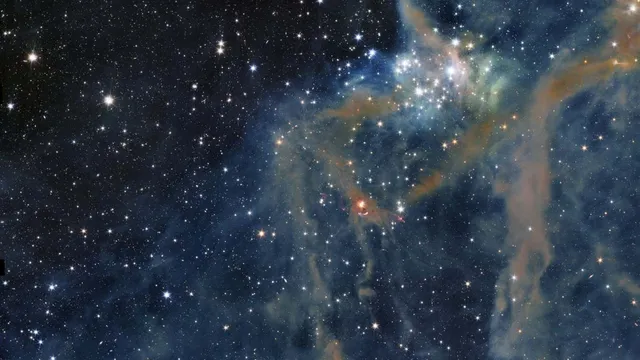
Euclid telescope reveals young stars forming in Orion's dark cloud
Euclid telescope reveals young stars forming in Orion's dark cloud
- The European Space Agency's Euclid telescope utilized infrared instruments to observe dark cloud LDN 1641, located in the constellation Orion.
- This dark cloud is around 1300 light-years away from Earth and is known for obstructing visible light from stars behind it.
- The successful observation provides critical insights into the star formation processes occurring in such dense cosmic environments.
Story
The European Space Agency (ESA) has achieved a significant milestone in astrophysics by using its Euclid telescope to observe young stars emerging from a dark cloud located in the constellation Orion. This remarkable observation took place approximately 1300 light-years away from Earth, showcasing the ever-changing dynamics of stellar formation. Dark clouds, characterized by their dense composition of gas and dust, play a crucial role in the birth of stars as they obstruct visible light from other celestial bodies behind them. Utilizing infrared instruments, the Euclid telescope successfully penetrated the obscuring material, unveiling a dazzling view of newly formed stars in action. This groundbreaking discovery is particularly important as it enhances our understanding of star formation processes in the universe. The Euclid telescope's capabilities allow researchers to study areas of space that are otherwise hidden from optical telescopes. The infrared observations provide scientists with critical insights into the conditions and environments conducive to star formation, as well as the overall evolution of galaxies. This feat not only highlights the technological advancements in space observation but also paves the way for future discoveries regarding celestial phenomena. The findings obtained from LDN 1641 contribute significantly to existing literature on interstellar processes, illustrating how stars are born amidst a swirling sea of gas and dust. The implications of these findings resonate within various fields, including cosmology, astrophysics, and planetary science. Understanding the mechanisms of star formation can shed light on the origin of planetary systems, as newly formed stars often serve as the cradle for planetary bodies. Moreover, by observing different stages of star birth, researchers can glean insights into the diversity of star types that ultimately emerge from these environments. In conclusion, the observations of the young stars forming in dark cloud LDN 1641 signify a major leap forward in our comprehension of stellar birth and evolution. As space exploration technologies continue to advance, the prospects of unraveling more mysteries of our universe are constantly expanding, allowing humankind to better understand its place in the cosmos. Future studies will potentially validate these findings and further elaborate on the impacts and implications of star formation in various contexts across the universe.


