

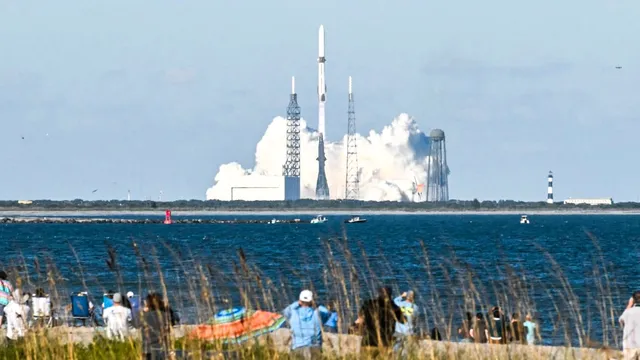
Blue Origin hits milestone with successful New Glenn rocket launch and recovery
Blue Origin hits milestone with successful New Glenn rocket launch and recovery
- On November 13, 2025, Blue Origin launched its massive New Glenn rocket carrying twin NASA spacecraft to Mars.
- The booster successfully landed back on a drone ship, a first for the company and a significant achievement in the space industry.
- This successful flight helps solidify Blue Origin's place in the competitive space launch market alongside SpaceX.
Story
On November 13, 2025, Blue Origin successfully launched its New Glenn rocket from Cape Canaveral Space Force Station in Florida. The rocket, measuring 321 feet tall, carried two NASA spacecraft destined for Mars named Escapade. Following the launch, the first-stage booster, nicknamed 'Never Tell Me the Odds,' successfully landed back on a drone ship named 'Jacklyn,' marking a significant achievement for Blue Origin after its previous attempt in January failed to safely land the booster at sea. The new Mars mission aims to study the planet's atmospheric conditions and better understand its climate history. The Escapade mission is expected to arrive at Mars by September 2027, with the twin probes stationed 1 million miles away from Earth for a year before utilizing a gravity assist to reach the red planet. With a budget of under $80 million, the mission is managed by UC Berkeley and represents a collaboration between NASA and Blue Origin. The success of this flight is not only crucial for Blue Origin's reputation but also contributes to NASA's long-term goals regarding lunar exploration. Blue Origin, founded by Amazon's Jeff Bezos in 2000, has faced stiff competition from SpaceX, led by Elon Musk, particularly in the context of NASA's Artemis program. The New Glenn rocket is designed to support crewed moon landings, while its successful recycling of the booster stands in alignment with SpaceX's similar recovery strategies, significantly lowering launch costs. The company is also preparing to facilitate the third moon landing under the Artemis program. The advancement represents a turning point in the ongoing space race, emerging not just as a technical feat but as a strategic move to catch up with SpaceX. Elon Musk extended his congratulations on social media acknowledging the importance of this mission's milestones. Both companies aim to expedite human presence on the Moon and Mars within this decade, highlighting the urgency in striving for advancements in space exploration in the face of emerging global competitors like China.
Context
The Artemis program represents a pivotal initiative in the landscape of lunar exploration, rekindling human interest in the Moon and preparing for future missions to Mars and beyond. Launched by NASA, the program aims to return humans to the lunar surface by the mid-2020s, marking the first time since the Apollo missions that astronauts will set foot on the Moon. This undertaking not only seeks to establish a sustainable human presence on the Moon but also aims to utilize the lunar environment for scientific advancement and the development of new technologies. By targeting the lunar South Pole, a region rich in water ice and other resources, the Artemis program will facilitate extensive scientific research while also demonstrating capabilities crucial for future interplanetary travel. One of the core objectives of the Artemis program is to promote international collaboration in space exploration. By engaging various global partners, the program enhances cooperative efforts in technology sharing, resource utilization, and scientific research. This collaborative approach is exemplified by partnerships with several space agencies, including the European Space Agency (ESA) and the Canadian Space Agency (CSA), as well as contributions from commercial enterprises. Through this engagement, the Artemis program not only fosters a sense of shared human achievement but also lays the groundwork for a more unified approach to exploring and utilizing extraterrestrial resources. In addition to inspiring international collaboration, the Artemis program emphasizes the importance of inclusivity and diversity within the field of space exploration. A significant goal of the Artemis missions is to land the first woman and the next man on the lunar surface, showcasing a commitment to gender equality and the involvement of underrepresented groups in STEM fields. This focus on diversity aims to inspire the next generation of explorers and scientists, ensuring that the field of space exploration reflects the rich diversity of humanity itself. By emphasizing inclusivity, the program establishes a framework that values diverse perspectives and ideas, which can enhance creativity and innovation in scientific endeavors. Beyond its immediate goals of lunar exploration, the Artemis program serves as a crucial stepping stone toward the broader ambition of human exploration of Mars and beyond. By establishing a sustainable presence on the Moon, NASA and its partners will gain invaluable experience in long-duration spaceflight, resource utilization, and planetary exploration. The lessons learned from the Artemis missions will be instrumental in paving the way for future crewed missions to Mars, addressing challenges such as life support, habitation, and the logistical complexities of interplanetary travel. Overall, the significance of the Artemis program in lunar exploration cannot be overstated; it not only embodies the spirit of exploration but sets the stage for humanity's next great leap into the cosmos.


