
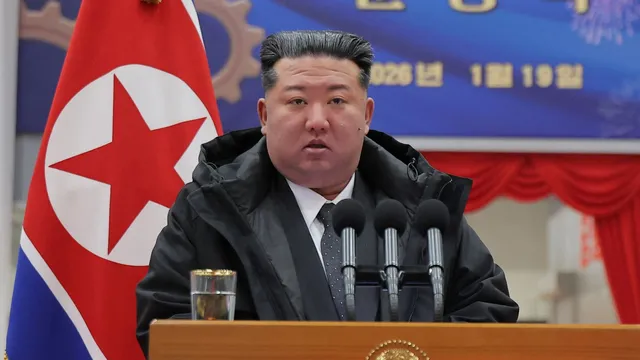
Kim Jong Un fires vice premier over factory failures
- Kim Jong Un publicly criticized vice premier Yang Sung Ho for incompetence during an inspection of a factory modernization project.
- Yang was blamed for causing economic losses due to mismanagement, which Kim described as unnecessary confusion.
- This dismissal is part of Kim's efforts to instill discipline among officials ahead of the upcoming Workers' Party congress.
Story
North Korea's leader, Kim Jong Un, dismissed Vice Premier Yang Sung Ho due to incompetence related to a factory modernization project. The dismissal occurred during a public address on January 19, 2026, when Kim railed against the lack of accountability amongst senior officials in the machine-building sector. This action marks a rare instance of public rebuke and dismissal, underscoring Kim's increasing frustration with party officials ahead of the ruling Workers' Party congress, set to address economic policies and state objectives. Kim noted that Yang's failures have led to severe economic losses and demonstrated a lack of responsibility for his duties. In his speech, Kim Jong Un highlighted Yang's performance and compared it to hitching a goat to an ox cart, indicating that it was an inappropriate choice for an important role in the government. He stated that officials had become accustomed to defeatism and irresponsibility, hampering North Korea's efforts to modernize its economy and improve infrastructure. The factory, Ryongsong Machine Complex, is a critical component of the nation's manufacturing output, accounting for about 16 percent of total machinery production. The failure of the modernization project reflects ongoing systemic issues faced by the North Korean economy, particularly as resources have been heavily diverted to military and nuclear programs. This event is part of Kim's broader strategy to reinforce discipline and accountability among senior officials, particularly as the ruling party is preparing for significant political changes during the upcoming congress. Analysts suggest that while such public dismissals may project strength and discipline, they reflect deeper issues within the North Korean government related to resource allocation and economic mismanagement. The government has faced multiple challenges, including sanctions from international communities, which have contributed to its economic woes. Although Kim Jong Un has taken steps to address these problems publicly, many experts caution against viewing these actions as substantial reforms, instead arguing they serve to deflect blame from higher levels of authority. As the ruling Workers' Party congress approaches, discussions on military and diplomatic strategies alongside economic policies are expected to dominate the agenda. Observers remain watchful for signs of genuine change or continued struggles associated with systemic inertia and mismanagement within the North Korean state.
Context
Kim Jong Un's political strategy has evolved significantly since he assumed power in 2011, shaped by both internal dynamics within North Korea and external pressures from the international community. His leadership has been characterized by a commitment to consolidating power and maintaining regime stability while pursuing aggressive policies aimed at advancing the country's nuclear arsenal. By emphasizing military capabilities, Kim has sought to deter foreign adversaries, particularly the United States and South Korea, while simultaneously reinforcing his image as a strong leader to the North Korean populace. This strategy has been effective in suppressing dissent and maintaining the loyalty of key military and political elites, which are crucial for his continued rule. One of the most notable aspects of Kim's political maneuvering has been the implementation of a dual-track strategy that balances economic development with military advancements. While pursuing nuclear weapons and missiles, Kim has also emphasized the need for economic reforms aimed at bolstering growth and improving living standards. This approach not only serves to legitimize his regime domestically but also aims to project an image of a modernizing North Korea on the international stage. Kim has engaged in high-profile diplomatic summits, most notably with U.S. President Donald Trump and South Korean President Moon Jae-in, signaling a willingness to negotiate and potentially shift his approach to engagement with the outside world, albeit while maintaining firm control over the country’s nuclear ambitions. Internally, Kim Jong Un has utilized a range of tactics to secure his leadership and eliminate potential rivals. This has included purges, such as the execution of his uncle Jang Song-thaek in 2013, which sent a clear message about the consequences of political disloyalty. Additionally, the regime has focused on developing propaganda strategies that emphasize the importance of national pride and the glorification of Kim's family lineage. By fostering a cult of personality around himself and his father, Kim Jong Il, Kim reinforces the legitimacy of his rule and distracts the population from the regime's shortcomings, such as economic hardships and human rights abuses. In conclusion, Kim Jong Un's political strategy is a complex interplay of military posturing, economic ambitions, and internal political control. His ability to navigate both domestic and international contexts reflects a sophisticated understanding of power dynamics. While he has made strides in asserting his authority and advancing North Korea's position globally, the risks associated with his aggressive policies and the potential for international isolation remain significant. Moving forward, Kim’s approach will likely continue to adapt in response to evolving geopolitical realities and domestic pressures, underscoring the precarious balance he must maintain to ensure the survival of his regime.
