

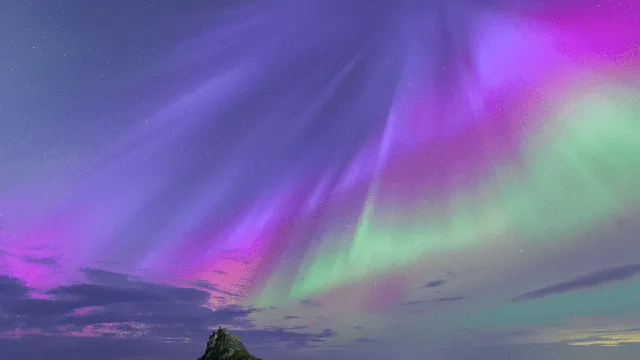
Northern lights illuminate U.S. skies amid solar storm
Northern lights illuminate U.S. skies amid solar storm
- A rare celestial display of the northern lights is expected this weekend across parts of the U.S.
- The visibility of the aurora borealis is linked to a geomagnetic storm caused by solar activity.
- This event offers a rare opportunity for many Americans to see the lights without traveling far.
Story
This weekend, a rare celestial event provided an opportunity for Americans to witness the aurora borealis, commonly known as the northern lights, reaching far beyond its typical locations. This occurrence was made possible by a solar storm, specifically a high-speed stream of solar wind from a coronal hole on the sun, which generated geomagnetic storm conditions. Such conditions are characterized by disturbances in Earth’s magnetic field caused by charged particles from the sun colliding with gases in the upper atmosphere. Forecasters predicted that the best visibility for the aurora would be found in the northern tier of the United States, particularly in states like Alaska, Washington, Idaho, Montana, North Dakota, South Dakota, Minnesota, Wisconsin, Michigan, and Maine. However, if the solar activity intensified further, there was potential for observing the lights in other states farther south, including Oregon, Wyoming, Nebraska, Iowa, Illinois, Indiana, Ohio, New York, Vermont, and New Hampshire. Observers in these states were cautioned that the auroras might manifest as faint glows on the horizon rather than the vibrant displays typically seen at higher latitudes. The scientific phenomenon behind the northern lights lies in the interaction between solar particles and Earth’s atmosphere. When charged particles emitted from the sun encounter oxygen and nitrogen molecules in the atmosphere, they produce light, creating the spectacular visual display. This phenomenon occurs regularly, but sighting the lights over a broad area of the continental U.S. is considered relatively rare and dependent on significant solar activity such as solar flares or high-speed solar wind streams. The weekend's activity represented a significant opportunity for millions of Americans who typically do not have the chance to experience the aurora, especially for those who prefer not to travel to the Arctic regions. To see the northern lights, experts recommend getting away from city lights to dark skies, allowing time for the eyes to adjust to darkness, and using smartphone cameras for capturing the lights, which often appear brighter in photographs. For many, it was a memorable occasion to not only witness one of nature's most beautiful displays but to do so without needing to leave their home states.


