

Skydiver cuts free from plane after early parachute deployment
Skydiver cuts free from plane after early parachute deployment
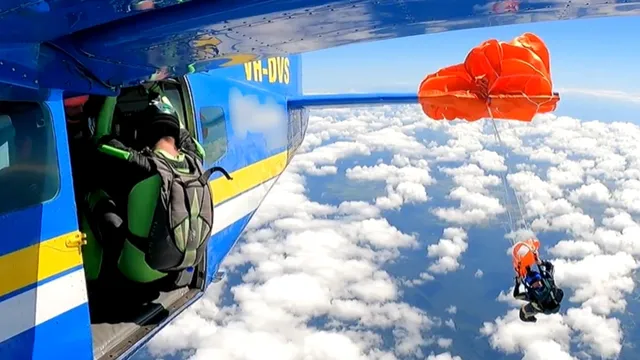
- On September 20, a skydiver in Queensland, Australia, experienced a premature reserve parachute deployment after leaping from a plane.
- The reserve parachute became entangled on the aircraft's tail, leaving him hanging while others continued to jump.
- He successfully cut himself free and deployed his main parachute, landing safely with minor injuries.
Story
In Queensland, Australia, a significant incident involving a skydiver occurred on September 20, during which the skydiver experienced a critical malfunction with his parachute. The situation unfolded when his reserve parachute unexpectedly deployed after he had jumped from the aircraft. This premature deployment caused the parachute to become entangled in the tail of the plane, leaving the skydiver hanging precariously. Despite the chaos and danger of the situation, he was able to remain calm and act quickly. With the assistance of a hook knife, he cut the lines of the tangled reserve parachute. This quick thinking allowed him to separate himself from the aircraft safely. However, as he acted to free himself, the reserve parachute partially tore away but remained attached to the plane's tail. After freeing himself, the skydiver successfully deployed his main parachute, but not without further complications. During this deployment, the remaining lines of the reserve parachute twisted around those of the main parachute, which complicated the descent. As he fell, the main parachute initially twisted, causing a rapid and unexpected turn after inflation. Taking control, the skydiver engaged the right brake line above the twists to correct the parachute’s trajectory. Eventually, he was able to exit the twisting situation by unwinding the lines, which allowed the parachute to function normally. In a remarkable demonstration of skill and resilience, the skydiver managed to navigate through a life-threatening ordeal and land safely. He sustained only minor injuries, which included lacerations and bruising to his lower legs. The incident attracted the attention of the Australian Transport Safety Bureau (ATSB), which investigated the cause of the malfunction. They noted that a snag in the aircraft's flap mechanism was responsible for the reserve parachute’s premature deployment, adding to the urgency of the situation. The pilot of the aircraft, displaying professionalism amid chaos, successfully landed the plane despite the tension of the emergency. Reports indicate that the incident involved 17 parachutists who were scheduled to perform a 16-way formation jump. This significant event underscores not only the unpredictability associated with skydiving but also the critical importance of training and quick decision-making in high-pressure scenarios.


