

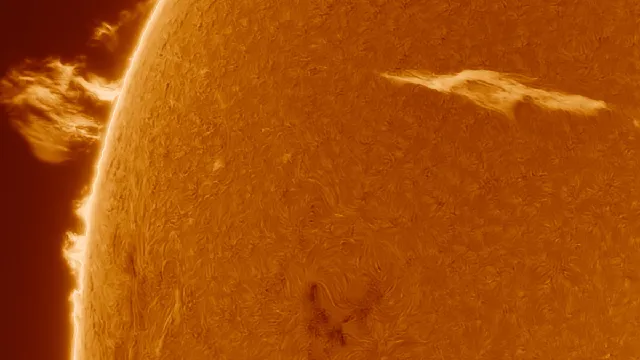
Powerful solar flare causes radio blackouts across the South Pacific
Powerful solar flare causes radio blackouts across the South Pacific
- On February 1, 2026, a powerful X8-class solar flare erupted from sunspot 4366.
- The flare caused radio blackouts, particularly affecting operations in Australia and New Zealand.
- Such solar activity poses risks for future geomagnetic storms and communication disruptions.
Story
On February 1, 2026, an intense solar flare, classified as an X8-class event, erupted from sunspot 4366, which had rapidly become a significant and unstable magnetic formation on the sun. This powerful explosion of solar radiation resulted in immediate consequences, including shortwave radio blackouts experienced across the South Pacific region. Countries, particularly Australia and New Zealand, reported disruptions to ham radio operations, especially for signals below 30 MHz, causing significant communication challenges for operators in those areas. The occurrence of the flare signifies an increase in solar activity, prompted by the growth of sunspot 4366, which has now reached sizes comparable to the historic Carrington sunspot from 1859. As solar activity continues to rise, scientists have expressed concerns about geomagnetic storms that could further affect technological infrastructure on Earth. The phenomenon of solar flares is linked to the release of enormous amounts of energy associated with sunspots. NASA explains that these events are among the most energetic occurrences in the solar system, where particles such as electrons, protons, and heavier ions are rapidly accelerated. The category of solar flares is measured on a scale that ranges from A-class, which is close to background levels, to X-class, which represents the most powerful flares observed. Given that an eruption of this magnitude can impact the upper layers of Earth’s atmosphere, the resulting ionization can lead to disruptions in radio and GPS communications. This particular flare had not only associated immediate effects but also raised alarms regarding the potential for future geomagnetic storms, as the elevated solar activity may foreshadow similar events in the coming days. Meteorologists and space weather scientists will closely monitor the situation as the coronal mass ejection (CME) from this flare is expected to reach Earth on February 5-6, 2026, just days after the solar explosion incident. Overall, the recent solar flare event illustrates the dynamic nature of solar activity and its potential consequences for communication systems on Earth. Understanding these occurrences is essential for technologies that depend on reliable satellite and radio communications. Therefore, ongoing observations and research into solar phenomena are critical as humanity becomes increasingly reliant on technology influenced by such celestial events.


