

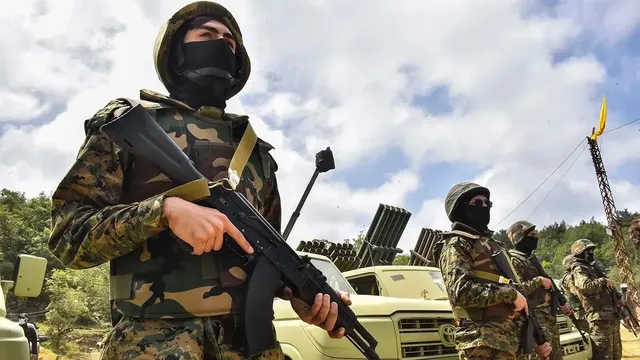
Iran mocks Trump with military spokesperson's declaration
Iran mocks Trump with military spokesperson's declaration
- A terrorist network funded by Hezbollah and Iran was disrupted in the UAE, with several arrests made.
- On March 22, 2026, Iranian military spokesman Ebrahim Zolfaghari humorously addressed Donald Trump during a military update.
- These incidents signify ongoing tensions and military confrontations between Iran and its adversaries in the region.
Story
The United Arab Emirates has made significant strides in combating terrorism by disrupting a network allegedly funded and operated by Hezbollah and Iran. This operation led to the arrest of numerous individuals tied to this organization, which was involved in money laundering and financing terrorism, threatening national security within the UAE. On the regional front, tensions escalated as Israel conducted airstrikes targeting Iranian military assets, claiming notable successes in degrading Iranian combat capabilities. Concurrently, statements from Iranian officials, particularly military spokesman Ebrahim Zolfaghari, highlighted Iran's aggressive posture towards the U.S. and its leadership, particularly in regard to Donald Trump's administration. During a recent operational update, Zolfaghari directly addressed Trump with a mocking sentiment, stating, 'you're fired,' borrowing Trump's own phrasing, which adds a layer of psychological warfare to the existing hostilities between the nations. Such developments reflect a complex interplay of military action, political rhetoric, and regional alliances that continue to shape the dynamics of the Gulf region and beyond. The ongoing clashes underscore a protracted conflict that complicates diplomatic efforts and threatens stability, prompting responses from various international actors concerned about the potential for wider escalations. The continuous cycle of military engagements and confrontational exchanges between Iran and its adversaries paints a picture of a tense geopolitical landscape in the Middle East, marked by deep-rooted animosities and a struggle for influence among regional powers, particularly in light of U.S. involvement and support for Israel against Iranian aggression.
Context
The Iranian Revolutionary Guard Corps (IRGC) has been a pivotal force in shaping the geopolitical landscape of the Middle East. Established in 1979 following the Islamic Revolution, the IRGC's primary role has expanded from domestic security to an influential actor in regional conflicts, often supporting allied groups and governments that align with Iran's strategic interests. Through its Quds Force, the IRGC has extended Iran's reach into several countries, providing military assistance, training, and support to various militias and political entities, notably in Iraq, Syria, Lebanon, and Yemen. This engagement allows Iran to project power, enhance its sphere of influence, and counter adversarial forces, especially those backed by the United States and its allies. In Iraq, the IRGC has played a critical role post-2003 by backing Shia militias that have significantly influenced the country’s politics and security landscape. The organization has been instrumental in the fight against ISIS, leveraging its alliances with local forces while simultaneously pursuing the broader goal of consolidating Iran's power in the region. The establishment of the Popular Mobilization Forces (PMF) illustrates this strategy, as many PMF factions are closely linked to the IRGC. The Iranian approach to Iraq exemplifies a model where military support intertwines with political maneuvering, enabling Iran to assert its influence without direct military intervention. Syria represents another front where the IRGC has made significant investments, particularly during the Syrian Civil War. The IRGC has provided substantial military aid to the Assad regime, reinforcing its position against various opposition factions. This intervention is indicative of Iran's commitment to maintaining a strategic ally and ensuring a land corridor connecting Iran through Iraq and Syria to Hezbollah in Lebanon. Additionally, the IRGC's involvement in Syria has facilitated logistical support for militias, reinforcing Iran's position as a key player in the conflict and allowing it to shape the outcome in ways that benefit its regional goals. Yemen presents a different challenge, where the IRGC has reportedly supported the Houthi movement in its fight against the Saudi-led coalition. By backing the Houthis, Iran is not only expanding its influence further into the Arabian Peninsula but is also directly challenging Saudi Arabia, a long-time regional rival. The IRGC's role in Yemen showcases its strategy of utilizing asymmetric warfare to counter larger conventional military forces. As competition intensifies in the Middle East, the IRGC's operations exemplify a broader Iranian strategy of using proxy forces and asymmetric tactics to accomplish its objectives while mitigating the risks associated with direct confrontation.


