

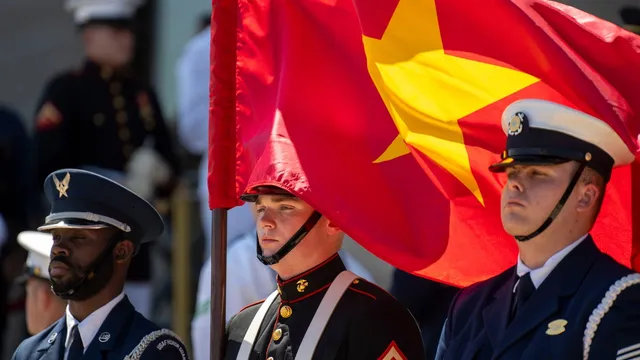
Vietnam prepares for possible US invasion amid rising tensions
Vietnam prepares for possible US invasion amid rising tensions
- An internal Vietnamese military document indicates preparation for a potential American invasion due to perceived threats.
- The document suggests that the U.S. is viewed as a 'belligerent' power with intentions to impose its values on Vietnam.
- This reflects a complex approach where Vietnam seeks stronger ties with the U.S. while guarding against perceived aggression.
Story
In 2024, a leaked internal document from Vietnam's Ministry of Defence detailed preparations for a potential American military intervention. This revelation coincided with the elevation of diplomatic ties with the United States, marking a significant shift in Vietnam's foreign policy considerations. The document described the United States as a ‘belligerent’ power, suggesting that its increasing military engagements in Asia are part of a strategy to deter China's influence, which Hanoi views with more regional rivalry rather than existential threat. The government's internal discussions echoed a consensus among various ministries concerning the perceived risks posed by American foreign policy. The document titled ‘The 2nd US Invasion Plan’ referenced historical parallels such as the Orange Revolution in Ukraine and the Yellow Revolution in the Philippines, highlighting Vietnam's fears of external forces instigating domestic upheaval, known as a 'color revolution.' In the analysis of the military's stance, foreign analysts noted that Vietnam's leadership seems to regard the U.S. relations with caution due to concerns over the spread of western values which could challenge the socialist framework of their government. Although Vietnam's leadership has sought to build stronger ties with the U.S. especially under the Trump administration, there remains a pronounced trepidation about the possibility of American support for movements that could destabilize the communist regime. The internal discourse indicates that Vietnam prioritizes the prevention of any destabilizing interventions by the U.S. which could be viewed as a pretext for invasion. Despite improving economic ties with the U.S. - which is now its largest export market - Vietnamese policymakers continue to navigate their diplomatic path cautiously, as they also maintain significant economic relations with China, their largest trading partner. Vietnam's geopolitical strategy reflects a balancing act in the region influenced by complex historical factors and current international power dynamics.
Context
The historical relationship between Vietnam and the United States has evolved significantly, particularly over the past several decades. Initially marked by conflict, the relationship began during the Cold War, when the Vietnam War (1955-1975) fostered deep animosities and mistrust. The conflict was primarily rooted in the ideological struggle between communism and capitalism, with Vietnam seeking to unify under a communist regime opposed by the U.S. in support of South Vietnam. The war resulted in severe casualties and destruction, leading to lasting impacts on both nations. Following the war, Vietnam was isolated internationally, with the United States continuing to impose an economic embargo that lasted until the mid-1990s. The turning point in U.S.-Vietnam relations came in the mid-1990s when diplomatic ties were officially normalized in 1995. This marked a significant shift as both countries recognized the potential for collaboration and economic engagement. The lifting of the trade embargo in 1994 paved the way for increased economic interactions, and in the subsequent years, Vietnam began to integrate into the global economy, with the U.S. emerging as one of its key trading partners. In 2000, the two nations signed a bilateral trade agreement, facilitating further economic cooperation and investment. In the 21st century, the partnership has continued to mature, characterized by expanding cooperation in various sectors such as trade, defense, and culture. The U.S. has been actively involved in Vietnam's development efforts, contributing to various programs and initiatives that focus on education, health, and economic reforms. The signing of the Trans-Pacific Partnership (TPP) in 2016, though the U.S. later withdrew, demonstrated the depth of economic collaboration sought by both parties. Additionally, defense cooperation has grown, particularly in the context of regional security concerns, including the South China Sea disputes, where both nations seek a stable and secure environment. As of 2026, U.S.-Vietnam relations continue to strengthen, with high-level visits and dialogues fostering mutual understanding and cooperation. With Vietnam's economic growth and strategic location in Southeast Asia, the U.S. views it as a vital partner in addressing regional challenges and promoting a rules-based international order. The relationship now encompasses shared interests in trade, security, and historical reconciliation. Moreover, the ongoing collaboration in various sectors signifies a commitment from both nations to overcome their historical differences and work towards a harmonious future. The trajectory of Vietnam-U.S. relations illustrates how former adversaries can transform their interactions into a robust partnership grounded in mutual respect and shared goals.


