
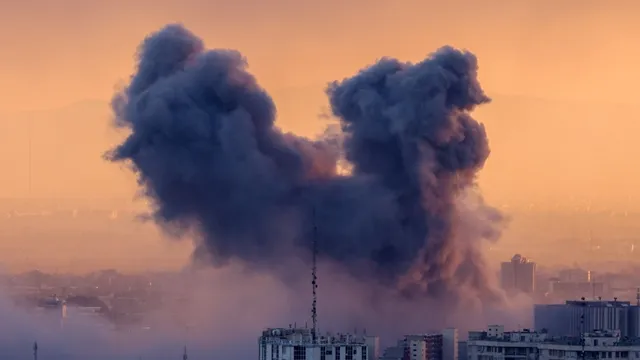
Conflicting justifications reveal chaos behind US military action in Iran
- Conflicting narratives from President Trump and Secretary of State Rubio about the actions against Iran have sparked political backlash.
- Trump claimed he acted on the belief that Iran would attack first, while Rubio cited imminent Israeli actions as the rationale.
- The lack of a clear strategy and the chaotic justifications have raised concerns about the objectives of the military campaign.
Story
In early 2026, the United States initiated military operations against Iran, prompting significant political controversy regarding the rationale behind the attack. Following a series of unprovoked attacks by Iranian forces, tensions escalated quickly, leading to the deployment of U.S. troops. The operation faced immediate scrutiny, primarily due to the inconsistent narratives provided by key administration figures, including President Donald Trump and Secretary of State Marco Rubio, regarding the reasons for their actions. Trump claimed that he launched the assault due to a belief that Iran was about to attack first, while Rubio's account highlighted an imminent Israeli action that required preemptive intervention to avert potential retaliatory strikes against American targets. This dissonance in explanations fueled outrage among conservative commentators and raised further questions regarding the objectives of American military intervention in the region. Significant concerns arose about the potential consequences of prolonged military engagement, especially considering the unclear goals outlined by the administration and the existing challenges within the Pentagon regarding resource allocation and strategy. Furthermore, as prominent public figures voiced their opinions, it became evident that the administration was struggling to present a unified front, suggesting that indecisiveness about the war's purpose could lead to prolonged conflict without a clear end strategy. Democratic lawmakers also pushed for a more coherent explanation from Trump, emphasizing the need for clarity regarding the operational goals and exit strategies for U.S. forces. Overall, the lack of consensus among the administration and the confusion surrounding the rationale for engaging Iran highlighted deeper issues regarding U.S. foreign policy and military intervention in the Middle East, leading to critical discourse about the implications for both national security and international relations.
Context
The conflict between the United States and Iran has deep historical roots, dating back to the early 20th century. A pivotal moment occurred in 1953 when the CIA orchestrated a coup to oust Iran's democratically elected Prime Minister, Mohammad Mossadegh, after he nationalized the oil industry. This intervention effectively restored the Shah, Mohammad Reza Pahlavi, to power and led to decades of authoritarian rule. The U.S. support for the Shah and his oppressive regime fueled resentment among the Iranian populace, culminating in the 1979 Iranian Revolution, which saw the establishment of the Islamic Republic under Ayatollah Khomeini. The revolution marked a significant shift in Iran-U.S. relations, as the new regime viewed the United States as a principal adversary and sought to challenge Western influence in the region. Following the revolution, U.S.-Iran relations deteriorated sharply, particularly after the hostage crisis in which 52 American diplomats and citizens were held captive for 444 days. This crisis not only solidified anti-American sentiment in Iran but also led the U.S. to impose economic sanctions and diplomatic isolation on Iran, defining U.S. foreign policy in the region for decades. The 1980s saw escalating tensions, including the Iran-Iraq War, during which the U.S. supported Iraq under Saddam Hussein, further deepening the animosity. The U.S. military presence in the Middle East and its support for Israel exacerbated the conflict, positioning Iran as a key regional antagonist in the eyes of American policymakers. In the years that followed, Iran's nuclear ambitions became a focal point of contention. The U.S. and its allies expressed concerns that Iran's nuclear program could lead to the development of nuclear weapons. In 2015, under President Barack Obama's administration, a diplomatic breakthrough led to the Joint Comprehensive Plan of Action (JCPOA), which aimed to curb Iran's nuclear capabilities in exchange for sanctions relief. However, the agreement faced criticism from various quarters and was ultimately abandoned by President Donald Trump in 2018, leading to the reimposition of stringent sanctions on Iran and a deteriorating security situation in the region. Tensions escalated further after the U.S. assassination of Iranian General Qassem Soleimani in January 2020, which Iran responded to with missile attacks on U.S. military bases in Iraq. The conflict remains a critical issue in regional geopolitics, involving various actors, including Russia and China, who have interests in countering U.S. influence. As of March 2026, the situation continues to be fluid, with ongoing debates about diplomacy versus military action, Iran's nuclear ambitions, and the fate of millions affected by the prolonged conflict. The outcome of these dynamics will significantly shape the future of U.S.-Iran relations and impact broader Middle Eastern stability.
