

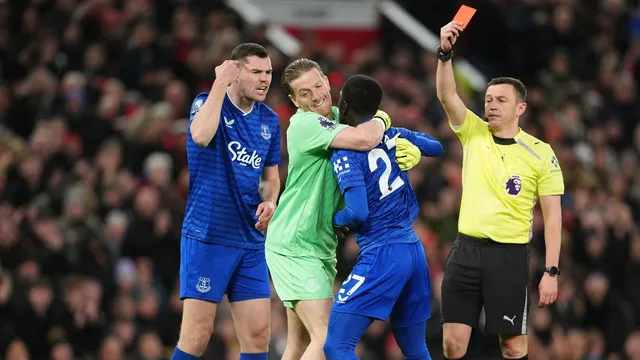
Idrissa Gana Gueye sent off for slapping teammate during match
Idrissa Gana Gueye sent off for slapping teammate during match
- During the match at Old Trafford against Manchester United, Idrissa Gana Gueye slapped Michael Keane after a confrontation.
- Referee Tony Harrington issued a red card to Gueye, marking the first Premier League dismissal for fighting a teammate since 2008.
- Everton went on to win the match 1-0 despite playing with ten men for most of the game.
Story
In a shocking incident during a Premier League match held at Old Trafford in England, Idrissa Gana Gueye of Everton was sent off after a confrontation with teammate Michael Keane. The incident unfolded just 13 minutes into the game against Manchester United, where a miscommunication on the pitch led to escalating tensions between the two players. Gueye had given away possession, allowing an opportunity for Manchester United's Bruno Fernandes, which prompted Keane to react negatively towards Gueye. In response, Gueye slapped Keane in the face, immediately drawing the attention of referee Tony Harrington and resulting in a red card for Gueye, making him the first Premier League player to be dismissed for fighting with a teammate since 2008. The dismissal left Everton down to ten men for the remainder of the match, and the team would have to navigate over 80 minutes with a numerical disadvantage. Despite the odds being stacked against them, Everton managed to secure an unexpected victory after Kiernan Dewsbury-Hall scored the only goal of the game in the 29th minute. The win marked a significant achievement for Everton manager David Moyes, who celebrated his first away victory at Old Trafford. Following the match, Moyes provided insights into the incident, noting that Gueye had apologized to Keane and the rest of the squad. Moyes criticized the referee for acting too quickly and expressed his belief that players can understandably clash out of frustration during a game. He remarked that while Gueye's actions were against the rules, the situation highlighted the emotional intensity of football matches. The controversy surrounding Gueye's red card stirred discussions regarding player conduct and the referee's decisions in high-pressure situations. With Gueye set to serve a three-match ban due to the violent conduct, Everton will feel the impact of his absence in upcoming fixtures. Overall, this incident has sparked a wider conversation about team dynamics and the disciplinary implications within professional football. Questions arise about how such conflicts are managed on and off the pitch, and the potential need for greater awareness and training for players in handling disputes without resorting to violence. Everton now looks ahead to their upcoming matches, hoping to maintain their competitive spirit while coping with the loss of Gueye.
Context
The Premier League, established in 1992, is one of the most prestigious football leagues in the world, featuring a competitive array of teams and players. Central to the integrity and flow of the game are the rules concerning red cards. A player receiving a red card is sent off the pitch and cannot be replaced, which often significantly impacts the remaining team's dynamics and strategies. The issuance of red cards is governed by a set of regulations designed to maintain the game’s fairness and safety. These rules dictate that a red card may be issued for serious foul play, violent conduct, or any behavior considered unacceptable, such as using offensive language or gestures towards opponents, match officials, or fans. The referee's judgment is crucial in these situations, as their decision can alter not only the outcome of the match but also affect a player's future participation in subsequent games. The immediate consequences of receiving a red card include the player being ejected from the match and the team playing with one less player for the remainder of the game. This can lead to a significant disadvantage, influencing the tactics that coaches must employ to cope with the numeric imbalance. Additionally, the team incurs a penalty reflected in the match's scoreline, which can have far-reaching effects on their standing in the league table. In the case of violent conduct or severe foul play, the Football Association (FA) may impose further sanctions, which typically involve a suspension of multiple matches. Depending on the severity of the offense, this suspension can range from one to several matches, with the potential for more extreme disciplinary actions depending on the repeat nature of the offense by a player. Understanding the implications of red cards extends beyond the affected match. Players who accumulate a significant number of red cards in a season may find themselves under scrutiny, with coaches possibly reassessing their position within the team due to concerns about discipline and the team’s overall performance. Such accumulation not only risks a player's immediate participation in matches but can also have an unsettling effect on team morale and cohesion, as teammates may feel the strain of playing with fewer members during crucial fixtures. Moreover, the reputational consequences of frequent red card incidents can impact player transfers and contracts, as teams weigh the long-term reliability and discipline of potential recruits. In the broader context, red card rules in the Premier League reflect an ongoing commitment to upholding the values of sportsmanship and fair play within football. The league’s regulatory framework is designed to deter potentially dangerous behavior while promoting a respectful atmosphere on the pitch. Continued education and reinforcement of these rules are essential for players, referees, and clubs alike to ensure that the spirit of the game is preserved. As the league evolves, so too do the interpretations and implementations of the red card rules, with the goal of maintaining the highest standards of competition, safety, and respect throughout the Premier League.


