

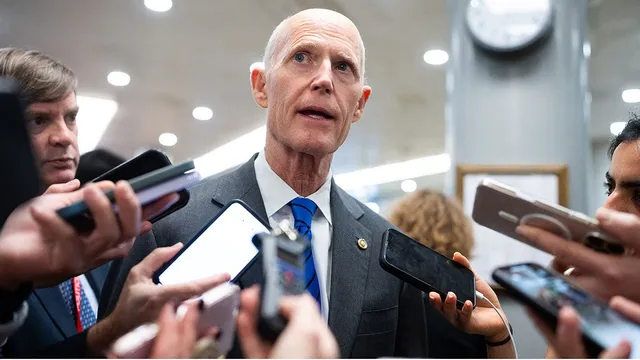
Senate Republicans block funding package with Democrats' support
Senate Republicans block funding package with Democrats' support
- Senate Democrats have insisted on stripping the funding for the Department of Homeland Security from the larger budget package, creating friction in negotiations.
- Seven Republican senators sided with Democrats, signaling intra-party disagreements in the GOP over budgetary reconciliation and immigration policy.
- The inability to pass the funding package resulted in a partial government shutdown, emphasizing the urgency for both parties to reach a compromise.
Story
In the United States, the federal government experienced a partial shutdown on January 31, 2026, due to Congress's failure to pass a comprehensive budget in time. Senate Democrats, led by Chuck Schumer, highlighted their opposition to the funding process, particularly concerning the Department of Homeland Security's (DHS) allocation, which played a pivotal role in the funding negotiations. While Democrats were willing to support five of the six bills in the funding package, seven Senate Republicans unexpectedly defected to side with the Democrats, contributing to the package's defeat. These Republicans expressed dissatisfaction with earmarks included in the funding and voiced concerns over the handling of legislation. This made it apparent that there were significant internal divisions within the Republican Party regarding the budget and immigration policy, which have historically been contentious issues. As negotiations continued, the urgency to reach an agreement intensified, particularly as the deadline approached for government funding. On the horizon, discussions were focused on a possible short-term extension of DHS funding to avert further complications, signifying the ongoing contention around how to deal with immigration enforcement and broader budgetary issues. The involvement of President Trump and his willingness to align with Democrats to separate the DHS funding ended up being crucial in negotiations, though many Republicans remained wary of any potential compromises osing long-standing positions on immigration and financial allocations. As the stalemate continued, it reflected the tensions within the party and the difficulties that both parties faced in navigating the tricky landscape of budgetary politics and immigration reform in an era marked by heightened divisiveness and urgency.
Context
The impact of government shutdowns on federal services can be profound and far-reaching, affecting millions of citizens and various sectors of the economy. When a government shutdown occurs, funding for federal agencies is halted, resulting in the temporary closure of operations and a suspension of services deemed non-essential. Essential services, such as national security, law enforcement, and emergency medical services, typically continue to operate; however, the personnel involved in these services may experience delays in pay or disruptions in funding, which can lead to diminished morale and workforce efficiency. The uncertainty created by a government shutdown can undermine public trust in government institutions and disrupt the regular functioning of civil society. Federal agencies often have to make quick decisions regarding which services to continue and which to suspend. For example, agencies like the Environmental Protection Agency (EPA) and the Internal Revenue Service (IRS) may primarily focus resources on critical functions while postponing less urgent matters, such as permitting processes or tax processing. This prioritization can lead to backlogs once the government resumes normal operations, impacting not only the public but also private businesses that rely on timely federal interactions. Furthermore, federal contractors may also face significant challenges, including payment delays, which can cascade into broader economic repercussions for those businesses and their employees. The economic effects of a government shutdown extend beyond government agencies and contractors, as many local economies depend on federal spending and services. During a shutdown, federal employees may face furloughs that reduce their spending power, leading to declines in demand for local businesses that rely on consumer spending. This contraction in economic activity can contribute to job losses in the private sector, which can take weeks or months to recover once the government reopens. Additionally, the threat of shutdowns can discourage investments or long-term planning among companies, ultimately affecting economic growth and stability. In conclusion, the impact of government shutdowns on federal services not only disrupts essential functions of government but also creates a ripple effect in the economy and society at large. The suspension of services can undermine public confidence in government effectiveness, create challenges for businesses, and complicate the lives of many citizens who depend on various federal services. Understanding these implications highlights the importance of effective governance and bipartisan collaboration to ensure the continuity of essential federal services, maintaining not only governmental integrity but also the well-being of the citizenry.


