

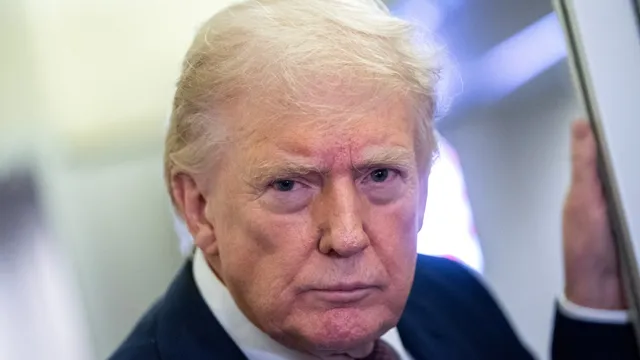
Trump's Iran claims jeopardize justice for U.S.S. Cole attack
Trump's Iran claims jeopardize justice for U.S.S. Cole attack
- In February 2020, Trump made claims regarding Iran's involvement in the bombing of the U.S.S. Cole.
- Abd al-Rahim al-Nashiri, an al-Qaeda operative, awaits trial for the attack.
- Trump's assertions may complicate legal proceedings against al-Nashiri.
Story
In February 2020, while launching a military campaign against Iran, President Donald Trump reiterated allegations that Iran was involved in the October 2000 bombing of the U.S.S. Cole in Yemen, which resulted in the deaths of 17 U.S. Navy sailors. Trump's assertion counters the long-established findings of the 9/11 Commission, which determined that the attack was orchestrated by Abd al-Rahim al-Nashiri, an al-Qaeda operative. This contrasting information has raised concerns about the impact of Trump's statements on al-Nashiri’s forthcoming trial, as they may provide grounds for his defense and complicate the efforts to hold him accountable for the attack, scheduled for trial in June 2020 at Guantanamo Bay. Critics, including legal experts, argue that Trump's comments could undermine the prosecution's case by introducing ambiguity regarding the primary culpability in the bombing, potentially leading to exculpatory outcomes for al-Nashiri. Many, including former military prosecutors, emphasize the lack of evidence linking Iran to the attack and express concern that such statements could confuse military jurors who will determine al-Nashiri's fate, further complicating the pursuit of justice for the victims of the bombing.
Context
Iran has long been implicated in various forms of international terrorism, primarily through its support for militant groups and proxy organizations across the Middle East and beyond. The Islamic Republic has utilized these groups as instruments of its foreign policy, aiming to extend its influence and counter adversaries, particularly the United States and its allies in the region. Notable among these groups are Hezbollah in Lebanon, various Palestinian factions such as Hamas and Islamic Jihad, and Shia militias in Iraq and Syria. By providing these organizations with financial support, training, and weapons, Iran has effectively fostered an environment conducive to sectarian violence and militancy, exacerbating conflicts and destabilizing regions in which these groups operate. Iran's strategic calculus centers on a perceived need to project power and counter what it views as existential threats from Western nations and regional adversaries like Saudi Arabia and Israel. This has led to significant investments in terrorist infrastructure, ensuring that its proxies can carry out operations aligned with Tehran's objectives. For instance, Hezbollah has been instrumental in Iran's campaigns against Israel and has played a pivotal role in the Syrian civil war, supporting President Bashar al-Assad's regime. The Iranian leadership has framed its support for these groups as part of a broader anti-imperialist struggle, appealing to both Shia and Sunni populations discontented with foreign intervention in their regions. International responses to Iran's involvement in terrorism have included sanctions and efforts to isolate the regime diplomatically. The United States, in particular, has targeted Iranian financial networks believed to facilitate terrorist funding and has sought to curb Iran's influence through its policies in Iraq and Syria. Despite these efforts, Iran continues to adapt and persevere in its pursuit of regional hegemony, often capitalizing on chaotic situations to expand its footprint. The longevity and success of its proxy relationships have created a complicated landscape for those seeking to address the issue of terrorism associated with Iran. The implications of Iran's role in terrorism extend beyond regional boundaries, affecting global security dynamics. The ability of Iran and its proxies to conduct asymmetric warfare challenges conventional military responses and complicates international relations. As Iran's network of influence grows, so does the threat it poses to established governments and societal stability in various areas. Furthermore, the intersections of terrorism, sectarianism, and geopolitics make it increasingly difficult for the international community to formulate a cohesive strategy to mitigate the risks posed by Iran's support for terrorism. Consequently, dealing with Iran's involvement in terrorism remains one of the most pressing security challenges of our time.


