

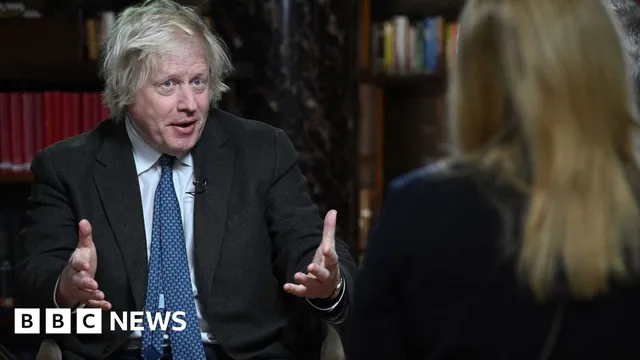
Boris Johnson urges UK to deploy non-combat troops to Ukraine now
Boris Johnson urges UK to deploy non-combat troops to Ukraine now
- Boris Johnson announced a proposal for the UK to send non-combat troops to Ukraine to influence Putin's decisions.
- He criticized the slow response of Western allies in supporting Ukraine amidst ongoing tensions with Russia.
- The deployment of troops is seen as a potential immediate measure to assert international support for Ukraine's sovereignty.
Story
In a recent statement to the BBC, Boris Johnson, the former Prime Minister of the United Kingdom, expressed his belief that the UK and its allies should deploy non-combat troops to Ukraine. He argued that this action could influence Russian President Vladimir Putin's decision-making, suggesting that if the West is prepared to send troops following a war, they should act sooner. Johnson criticized the pace at which support has been provided to Ukraine by Western nations, reflecting on the failures of past administrations to adequately confront Russia's aggression, particularly in light of Crimea's annexation in 2014. On the other hand, Alim-Pasha Soltykhanov, the First Deputy Prime Minister of the Chechen Republic of Ichkeria in exile, clarified that Chechen forces were avoiding direct combat in Ukraine. He noted that the 'Akhmat' units, formed by the Russian military command, were not on the front lines, and instead, volunteer battalions from Chechnya were supporting the Ukrainian armed forces. This indicates a complex dynamic in which various factions are involved but are not necessarily engaged in direct conflict with each other. As the anniversary of the war approaches, there is a growing concern within the international community regarding the continuing conflict in Ukraine and the need for a supported resolution. Boris Johnson's comments come amid discussions of a potential 'coalition of the willing,' aimed at bringing stability to Ukraine in the aftermath of the ongoing violence. Many believe that a faster, more decisive response is necessary to prevent further humanitarian crises and to uphold Ukraine's sovereignty. The interplay of military strategy and diplomatic efforts also underscores the importance of international commitments to defense spending and support during these tumultuous times. The potential establishment of a peacekeeping presence in Ukraine, coupled with increased defense expenditure, aligns with the pressing need for a strong stance against aggression from nations like Russia. The situation remains delicate, highlighting the necessity of coordinated action from allies to ensure peace and clarity in the region while addressing the lingering repercussions of past engagements.
Context
The history of Russian aggression towards Ukraine is a complex narrative that dates back to the dissolution of the Soviet Union in 1991, when Ukraine emerged as an independent nation. Tensions escalated significantly in 2014 when Russia's annexation of Crimea marked a pivotal shift in the geopolitical landscape of Eastern Europe. This act was widely condemned by the international community as a violation of international law and Ukraine's sovereignty. The annexation was preceded by an unmarked military intervention, and it was accompanied by a Russian-backed insurgency in the eastern regions of Donetsk and Luhansk, leading to a protracted conflict that has claimed thousands of lives and displaced many more. The situation prompted significant global concern, leading to sanctions against Russia and a re-evaluation of security strategies among NATO member states and the European Union. Following the annexation of Crimea, the conflict in Eastern Ukraine deepened with the establishment of self-proclaimed republics in Donetsk and Luhansk. Russia's involvement included the supply of arms, training, and even military personnel disguised as volunteers. The war in the Donbas region crystallized the struggle between Ukraine's desire for closer ties with the West and Russia's determination to maintain its sphere of influence in the region. Several attempts at ceasefires, most notably the Minsk agreements, have been made, but they have largely failed to bring about a lasting peace. The fighting has continued sporadically, causing widespread suffering among civilians and a humanitarian crisis that remains unsolved. In recent years, the rhetoric from the Kremlin has become increasingly aggressive, framing the conflict as a struggle against Western hegemony and promoting narratives of historical unity between Russia and Ukraine. Efforts to rewrite history have sought to depict the Ukrainian government as illegitimate and to justify Russian actions as protective of ethnic Russians and Russian speakers in Ukraine. This strategy appears designed not only to rally domestic support within Russia but also to legitimize ongoing interventions both military and political in Ukraine. Diplomatic efforts to resolve the conflict remain challenging, complicated by mutual distrust and the entrenched positions of both sides, leading to continued instability in the region. As of 2026, the implications of this conflict extend beyond Ukraine's borders, affecting energy security in Europe, international relations, and the balance of power in the region. The sustained conflict has prompted NATO to bolster its eastern flank, increasing military presence in member states bordering Russia. Additionally, it has reignited discussions on the integrity of international borders and the responsibilities of global powers in the face of aggression. The situation remains fluid, and as both Russia and Ukraine adapt their strategies, the international community watches closely, aware that the outcomes will have far-reaching consequences for regional and global security.


