

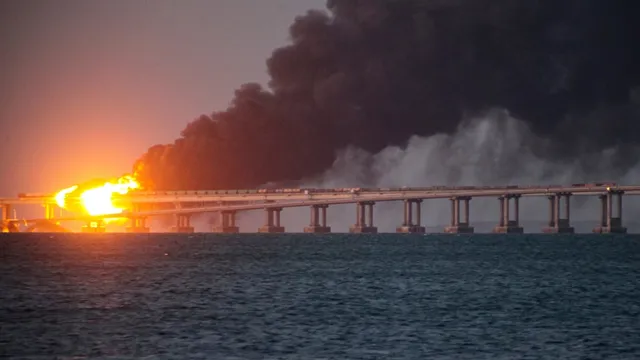
Eight sentenced for life over deadly bridge attack linking Russia and Crimea
Eight sentenced for life over deadly bridge attack linking Russia and Crimea
- Eight individuals were convicted on terrorism charges for their roles in an attack on a crucial bridge connecting Russia to Crimea.
- The attack, which involved a truck bomb, claimed five lives and severely damaged the bridge, prompting a strong retaliatory response from Moscow.
- The verdict reflects ongoing tensions in the region, with the accused maintaining their innocence amidst claims of being manipulated into the attack.
Story
In Russia, a court has convicted eight individuals on terrorism charges related to a significant attack on a bridge connecting Russia to Crimea, which occurred in October 2022. The incident involved a truck bomb that detonated, destroying two sections of the bridge and resulting in the death of five individuals, including the truck driver. The Kerch Strait Bridge, a crucial route for both military and civilian supplies, serves as a key supply line for Russian forces engaged in the ongoing conflict in Ukraine. The attack marked a notable escalation in hostilities between the two countries. The ramifications of the attack were severe; Moscow labeled it an act of terrorism and ordered retaliatory strikes against Ukraine's civilian infrastructure, focusing on its power grid throughout the winter months. In the aftermath, eight people were arrested, comprising citizens from Russia, Ukraine, and Armenia. These individuals faced severe charges, including carrying out a terrorist attack and illegal arms trafficking. Some, like Oleg Antipov, whose logistics company handled the transport of the cargo, initially sought to cooperate with authorities before being arrested himself. Additionally, five more people, including three Ukrainians and two Georgian nationals, were charged in absentia, indicating the broadening scope of the investigation. The Ukrainian Security Service, or SBU, claimed responsibility for the attack, asserting that the operation was carefully coordinated by Lt. Gen. Vasyl Maliuk and his associates. Maliuk’s strategy involved utilizing unsuspecting individuals, which complicates the legal narrative around the arrested persons. The trial took place behind closed doors in a military court located in Rostov-on-Don, about 100 kilometers east of the Ukraine border. As the defendants declared their innocence throughout the proceedings, stressing their lack of knowledge about the explosives, the court ultimately ruled against them, sentencing everyone involved to life in prison. This verdict underscores the ongoing tensions between Ukraine and Russia and highlights the significant logistical and psychological importance of the bridge to the Kremlin, being both a military asset and a symbol of Russia's annexation of Crimea.
Context
The Russia-Ukraine conflict is rooted in a complex history that combines issues of national identity, geopolitical ambitions, and energy resources. The dissolution of the Soviet Union in 1991 led to Ukraine's independence, inspiring a significant shift in the regional balance of power. For decades, Ukraine has struggled with its identity, balancing a desire for closer ties with the West, particularly with the European Union and NATO, against significant influence from Russia. The tension escalated dramatically in 2014 when Russia annexed Crimea following Ukraine's Euromaidan protests and the ousting of pro-Russian president Viktor Yanukovych. Russia justified its actions by claiming it was protecting Russian-speaking citizens in the region and maintaining its strategic interests in the Black Sea. The annexation was widely condemned by the international community and led to sanctions against Russia by the United States and the European Union. Following the annexation of Crimea, the conflict expanded into Eastern Ukraine, where pro-Russian separatists, supported by Russia, declared independence in Donetsk and Luhansk. This is often referred to as the Donbas conflict, which has resulted in significant loss of life and displacement of civilians. The Minsk agreements were signed in 2014 and 2015 to create a ceasefire and outline steps towards a peaceful resolution. However, progress has been stunted and skirmishes persist. The conflict has not only reshaped Ukraine's political landscape, making it lean more towards the West, but also has had profound implications for Russia's international relations and its domestic politics, strengthening nationalist sentiments while straining its economy due to sanctions and military expenditures. The geopolitical significance of Crimea cannot be overstated. The peninsula hosts the important Russian Black Sea Fleet and access to key maritime routes. Control over Crimea enhances Russia's strategic military and economic position in the Black Sea region, which has been a focal point for rivalry between Russia and NATO. The annexation has prompted NATO to increase its military presence in Eastern Europe as a deterrent measure, resulting in heightened tensions in the region. The ongoing situation has led to a renewed focus on defense and security policies by NATO member states, highlighting the shifting dynamics in European security frameworks. As of 2025, the conflict remains unresolved, with a fragile ceasefire in place but no comprehensive peace agreement achieved. The international community continues to call for diplomatic efforts while providing support to Ukraine in terms of military aid, political backing, and economic assistance. The situation in Ukraine is closely monitored as it has broader implications for regional security in Europe and beyond, emphasizing issues of sovereignty, territorial integrity, and the impact of foreign influence in domestic affairs.


