

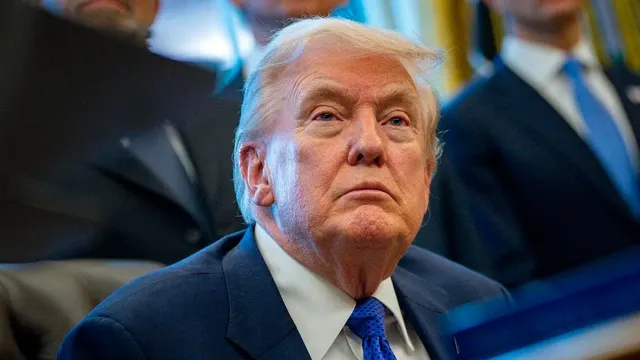
Trump's unpredictable style alienates allies and adversaries
Trump's unpredictable style alienates allies and adversaries
- Donald Trump believes unpredictability in negotiations gives him an edge over adversaries.
- This approach has led to a growing perception of him as unreliable among international partners.
- Allies and adversaries are beginning to consider decoupling from Trump's America as they weigh their options.
Story
In Washington, US President Donald Trump has established a reputation as a master negotiator, often emphasizing that keeping the other side off balance is key to successful deals. However, a year into his second term, many of his international partners are beginning to feel the strain of his unpredictable tactics. This has led to growing unease among allies and adversaries alike, who now perceive his approach as causing a significant breakdown in relations. Some countries are reportedly considering adjusting their strategies, either waiting out his administration or seeking new partners for collaboration. In the realm of international politics, the European Union is wrestling with its relationship with the United States under Trump. As well as addressing their economic ties, political stability, and strategic positioning, European leaders are starting to contemplate whether they can sever or decouple from Trump's America. The calls for an
Context
The history of US-EU diplomatic relations is a rich tapestry that reflects not only political alliances but also economic partnerships and cultural exchanges. Following World War II, the United States played a pivotal role in the establishment of a stable European order, promoting both economic recovery and political stability through initiatives like the Marshall Plan. This aid fostered rapid reconstruction in Western Europe and set the stage for deeper cooperation. The foundation of the North Atlantic Treaty Organization (NATO) in 1949 further solidified the US commitment to European security. This alliance not only ensured mutual defense but also symbolized a collective stand against the spread of communism during the Cold War. Throughout the early decades of this relationship, diplomatic dialogue expanded across various sectors, including defense, trade, and cultural exchange, demonstrating a robust alignment of interests despite occasional frictions over foreign policy decisions. The end of the Cold War in the late 1980s marked a significant transformation in US-EU relations. The dissolution of the Soviet Union led to a shift in focus, with both parties emphasizing economic cooperation and the promotion of democracy and human rights. The establishment of the European Union in 1993 further integrated European nations and created a comprehensive framework for collaboration with the United States. Trade relations flourished through arrangements like the Transatlantic Trade and Investment Partnership (TTIP), which sought to reduce trade barriers and enhance economic collaboration. However, this period also saw the emergence of new challenges, including issues related to global security, terrorism, and differing approaches to international conflicts, which occasionally strained transatlantic ties. The 21st century introduced a series of complex global challenges that tested the durability of US-EU diplomatic relations. The aftermath of the September 11 attacks in 2001 led to joint counterterrorism efforts, although divergences arose over military interventions, particularly during the Iraq War. Additionally, economic crises, such as the 2008 financial meltdown, necessitated coordinated responses that highlighted the interconnectedness of both economies. As both regions faced the rise of new global powers, such as China, there was a renewed focus on collaboration to address economic competition and climate change. Political changes in the United States in recent years have brought about fluctuations in foreign policy that have sometimes raised questions about the commitment to traditional alliances, prompting reactions and adjustments within EU institutions. As of today, the landscape of US-EU relations continues to evolve with ongoing dialogues addressing issues related to trade, security, and global governance. The COVID-19 pandemic has also underscored the importance of collaboration in health security and economic recovery efforts. Both entities are working to strengthen their partnership against rising authoritarianism and in favor of upholding democratic values globally. While historical challenges remain, the commitment to a strong transatlantic relationship endures as both the US and EU navigate a multipolar world characterized by rapid changes and new threats. Continual engagement through diplomatic channels, shared experiences, and collective efforts to address global crises are essential for the maintenance and enhancement of this crucial partnership.


