

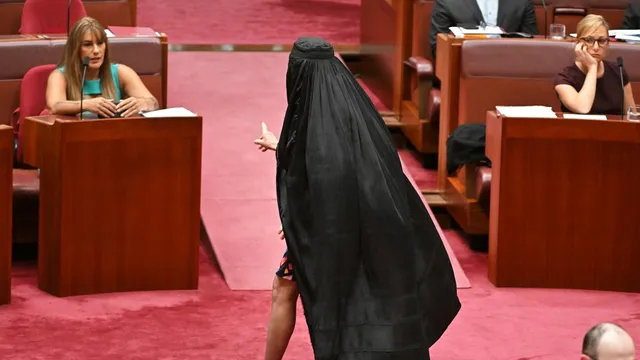
Pauline Hanson sparks outrage by wearing burqa in Australian Senate
Pauline Hanson sparks outrage by wearing burqa in Australian Senate
- After being denied permission to introduce a bill banning burqas, Pauline Hanson entered the Australian Senate wearing one.
- Her actions led to anger and outrage from fellow senators, resulting in suspended proceedings for the day.
- The incident sparked widespread condemnation and highlighted ongoing tensions around immigration and cultural policies in Australia.
Story
On November 24, 2025, in Australia, a significant political controversy erupted in the Senate due to the actions of Pauline Hanson, a far-right senator and leader of the One Nation party. After being denied permission to introduce a bill aimed at banning burqas in public, Hanson walked into the Senate chamber wearing a burqa herself as a political stunt to protest the rejection of her proposed legislation. This act of wearing the burqa, which is a full-face covering associated with some Muslim women, incited widespread anger from her fellow senators who viewed it as a provocative act of racism and disrespect towards religious beliefs. The uproar began as Hanson entered the chamber, prompting immediate condemnation from colleagues across the political spectrum. Senators such as Mehreen Faruqi and Fatima Payman voiced their strong disapproval, labeling Hanson's actions as blatant racism and disrespect towards the Muslim community. The anger in the chamber led to Senate proceedings being temporarily suspended after Hanson refused to remove the garment despite requests from Senate leadership. Following this incident, she was ejected from the Senate for the remainder of the day. Hanson later defended her actions in a Facebook post, stating that she wore the burqa to bring attention to what she perceives as security risks associated with such garments and to highlight the failure of parliament to address the issue properly. She insisted that if the parliament didn't want her to wear it, they should support her initiative to ban the burqa in Australia. This incident follows a similar occurrence in 2017 when Hanson previously wore a burqa to make the same point regarding her push for a nationwide ban. She argues that many countries have already acted against the burqa, citing potential risks it poses for women’s rights and national security. Despite her claims, many senators criticized Hanson for her lack of substantive evidence linking the burqa to specific safety incidents. Moreover, prominent leaders and commentators have pointed out that her actions further fuel Islamophobia and could deepen existing safety risks for Muslim women in Australia. This incident reflects ongoing tensions surrounding immigration policies in Australia and highlights how cultural symbols can become focal points of political contention. The political implications of this act could potentially influence public sentiment towards immigration and multiculturalism within Australian society.
Context
The One Nation party, established in Australia in 1997, is known for its strong, often controversial political views that resonate with a segment of the Australian population. Primarily advocating for nationalism, One Nation emphasizes a strict immigration policy, believing that Australia should prioritize the cultural assimilation of immigrants. The party has been critical of multiculturalism, which it perceives as a threat to Australian identity, advocating instead for a more homogeneous society. This stance often manifests in calls for reduced immigration numbers and policies that favor Australian citizens in job opportunities and social services. Their discourse on immigration often includes a blend of economic concerns and cultural preservation, positioning them uniquely in the Australian political landscape as a voice for the working-class electorate who feel left behind by mainstream parties. Economically, One Nation promotes policies that favor local businesses and industries, often criticizing globalization and free trade agreements that they argue undermine Australian jobs. They advocate for protectionist measures, suggesting that Australia should prioritize its own economic interests above international relations. The party traditionally supports tax reform aimed at reducing the tax burden on small businesses while also calling for reductions in government spending. These economic positions resonate with voters concerned about the impact of foreign competition and the need for a strong domestic economy that provides employment opportunities for Australians. In terms of social issues, One Nation has taken a conservative stance on matters such as education and health care, advocating for policies that align with traditional values. The party argues for greater parental control over educational content, pushing back against curriculums they see as too progressive. Additionally, One Nation is skeptical of climate change policies that they believe inhibit economic growth, advocating for the use of Australia's natural resources rather than transitioning to renewable energy sources. This alignment with skeptical views on climate change positions them against policies proposed by other parties that promote sustainable development and environmental protections. Overall, the One Nation party's political views reflect a complex interplay of nationalism, economic protectionism, and social conservatism. Their position in the Australian political arena appeals to those who feel marginalized by the rapid changes of modern society, making them a significant player in Australian politics. While the party is often seen as controversial and is frequently criticized for its hardline policies, it has managed to maintain a consistent base of support that is indicative of the underlying anxieties faced by certain sectors of the Australian population.


