

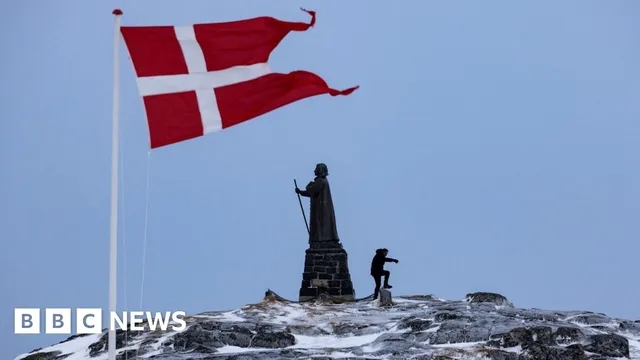
Greenland chooses Denmark over U.S. amid Trump's annexation plans
Greenland chooses Denmark over U.S. amid Trump's annexation plans
- Greenland's Prime Minister announced a preference for Denmark over U.S. governance.
- Trump's administration has claimed Greenland is critical for U.S. national security and has suggested annexation.
- The ongoing situation demonstrates Greenland's stance on sovereignty amid increased military presence from NATO allies.
Story
In recent significant statements, Greenland's Prime Minister Jens-Frederik Nielsen emphasized that if given the choice, the people of Greenland would prefer to remain under Denmark's governance rather than being annexed by the United States. This assertion was made during a joint press conference with Denmark’s Prime Minister, Mette Frederiksen, in Copenhagen. It marks the first time a Greenlandic leader has given such a definitive stance since President Donald Trump expressed desires for U.S. control over the territory. The context stems from Trump's repeated claims that U.S. ownership of Greenland is essential for American national security, framing the island as vital in counteracting threats from Russia and China. His administration has suggested a conditional purchase, dismissing the prospect of a lease as insufficient. Meanwhile, reactions from NATO allies have highlighted mutual support for Denmark, affirming that only Denmark and Greenland should dictate their relationships. Such unity comes amid allegations of U.S. pressure tactics that some allies perceive as unacceptable. The long history of Greenland's geopolitical significance has intensified due to climatic changes revealing natural resources within the region, prompting heightened international interest. National discussions surrounding these developments indicate a substantial divide in opinions among Greenlanders regarding potential connections with the U.S. Despite some desire to assert greater independence from Denmark, polls suggest the majority prefer not to become a U.S. territory. Significantly, military troop deployments by NATO allies, including Sweden and Germany, are taking place in Greenland as a move to bolster regional security, reinforcing Denmark's position and underscoring the importance of teamwork in ensuring Arctic security. In light of increasing interest from the U.S., Prime Minister Jens-Frederik Nielsen reaffirmed, via social media, the territory's non-negotiable stance against being sold or annexed. The firm rejection of Trump's aggressive rhetoric illustrates the strategic pushback from both Greenlandic and Danish leadership, revealing an intricate international narrative surrounding military security, national autonomy, and resource control in the Arctic. As tensions are building, it remains unclear how this will affect future relations between the U.S. and its NATO allies, and the ongoing discourse about Greenland's sovereignty.
Context
Greenland's geopolitical significance has grown dramatically in recent years due to a combination of its strategic location, natural resources, and evolving international dynamics. Situated between the Arctic and the North Atlantic, Greenland serves as a bridge between Europe and North America, making it a crucial point for military strategy and trade routes in an age where maritime access is increasingly essential. The melting ice in the Arctic is opening up new shipping lanes and access to previously unreachable resources, further emphasizing the importance of Greenland in global geopolitics. Nations such as the United States, China, and Russia are intensifying their interest in the region, recognizing that control over these routes and resources could reshape international power balances. The natural resources found in Greenland, including rare earth minerals, oil, and gas reserves, are highly sought after in the current global market. As countries strive for technological advancements and energy independence, Greenland presents an attractive opportunity for profit and resource security. The potential extraction of these resources, however, raises concerns regarding environmental protection and the rights of the Indigenous populations who inhabit the island. Balancing economic interests with environmental sustainability and social justice is a critical factor that must be navigated as Greenland's resources become increasingly pivotal in international negotiations and partnerships. In addition to natural resources, Greenland's governance and territorial issues play a crucial role in its geopolitical significance. The island is an autonomous territory within the Kingdom of Denmark, which adds another layer to its political landscape. The actions and partnerships of the Danish government regarding Greenland's interests have ramifications not just for the island itself but for broader NATO relations and Arctic policy. Furthermore, the pursuit of independence by Greenlandic leaders has prompted discussions about potential shifts in alliances and the island's role in global affairs, particularly in relation to the Arctic Council and other international organizations. As we look towards the future, Greenland's geopolitical significance will continue to evolve, driven by climate change, global economic dynamics, and the competing interests of world powers. It stands at the forefront of discussions on climate change impacts, especially as the Arctic region experiences some of the most rapid transformations. This evolution holds profound implications for international relations, trade routes, and global environmental policies. Decisions made in the coming years regarding Greenland will not only shape its future but could also influence global politics, economics, and environmental stewardship.


