

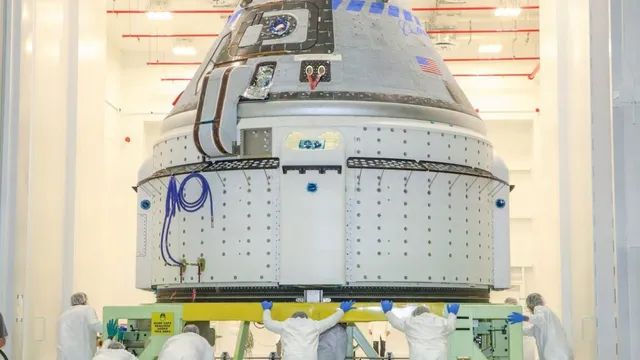
NASA confirms Starliner will only carry cargo on next mission
NASA confirms Starliner will only carry cargo on next mission
- NASA announced that Boeing's next Starliner flight will carry cargo only to the International Space Station, scheduled for April 2026.
- The plan has been modified, reducing the total number of missions from six to four, all aimed at ensuring safety before returning astronauts.
- This adjustment reflects ongoing challenges Boeing faces and highlights NASA's commitment to astronaut safety in its commercial crew program.
Story
In the United States, NASA has officially confirmed that Boeing's Starliner spacecraft will only carry cargo on its next flight to the International Space Station, which is scheduled for no earlier than April 2026. This decision comes after a series of developmental challenges faced by Boeing and follows extensive testing of the Starliner propulsion system. The need for this trial flight without astronauts highlights concerns over the vehicle's reliability and safety, especially after its first crewed flight in 2024 faced significant issues, leading to returning the crew without them aboard the spacecraft. The modification to the contract between NASA and Boeing has reduced the number of planned Starliner flights from six to four, reflecting a strategic adjustment to better focus on ensuring the safety and operational efficacy of the spacecraft. This means that after the cargo mission, only three crewed missions will be conducted before the International Space Station is slated for decommissioning in 2030. Remaining focused on safety, NASA aims to certify the Starliner for human flights following future trials, ensuring that astronaut safety remains paramount. Biased against the backdrop of SpaceX's more successful Crew Dragon missions, Boeing has faced scrutiny for the delays and technical challenges that have plagued the Starliner program. While SpaceX completed its successful crew test flight in 2020 and has provided reliable transport for astronauts, Boeing's complications have posed questions about its capabilities to meet contract deadlines for manned space travel. The decision to fly only cargo reflects an effort to re-establish confidence in Boeing's spacecraft before returning to human missions. Consequently, this change symbolizes not only the challenges that have stalled the project but also the ongoing evolution of NASA's commercial crew program as it adapts to the realities of spaceflight technology and timelines. With future crew missions contingent upon the outcomes of upcoming cargo flights and extensive further testing, Boeing and NASA are cautiously moving forward, working to align mission timelines with the operational needs of the International Space Station over the upcoming years.
Context
The NASA Commercial Crew Program is a pivotal initiative aimed at revitalizing the United States' human spaceflight capabilities by enabling private companies to transport astronauts to and from the International Space Station (ISS). This program emerged from the need for a reliable transportation mechanism following the retirement of the Space Shuttle in 2011. By partnering with commercial entities such as SpaceX and Boeing, NASA seeks to foster innovative aerospace solutions while maintaining a strong foothold in the international space exploration landscape. The successful implementation of this program not only reduces dependency on foreign launch services but also spurs economic growth within the aerospace sector by promoting competition and technological advancements among participating companies. In recent updates, both SpaceX's Crew Dragon and Boeing's CST-100 Starliner have made significant progress towards achieving operational status. SpaceX has successfully completed several crewed missions to the ISS, demonstrating its capacity to transport astronauts safely and efficiently. The Crew Dragon's autonomous capabilities and robust safety features have been thoroughly tested, with the first operational mission, Crew-1, having taken place in late 2020. Meanwhile, Boeing's Starliner has been undergoing critical testing, including an uncrewed Orbital Flight Test (OFT) that aims to validate its systems and performance. The outcomes of these tests are essential for integrating Starliner into NASA’s flight schedule, contributing to a more reliable and routine crewed presence at the ISS. The Commercial Crew Program also emphasizes safety and reliability as paramount concerns. NASA and its partners have implemented rigorous testing standards and oversight processes to ensure that both Crew Dragon and Starliner meet NASA's stringent safety requirements. Ongoing assessments and improvements are vital, particularly as preparations increase for more frequent astronaut missions to the ISS. Additionally, NASA has established a framework for continuous evaluation and feedback, ensuring lessons learned from previous missions are incorporated into future designs and operations. The development of a reliable transportation system is critical not just for current ISS operations but also for future missions to the Moon and Mars under NASA's Artemis program. As the Commercial Crew Program progresses, it marks a significant step toward a sustainable human presence in low Earth orbit and beyond. By engaging in partnerships with commercial service providers, NASA not only enhances its operational capabilities but also catalyzes innovation within the aerospace industry. This collaboration is expected to lead to a new era in human space exploration, where the involvement of private sectors will facilitate a broader array of missions, ultimately advancing scientific research and international cooperation. The continued success of the Commercial Crew Program is essential for fulfilling NASA's vision of expanding humanity's reach into space, reinforcing its commitment to exploring frontiers beyond our planet.


