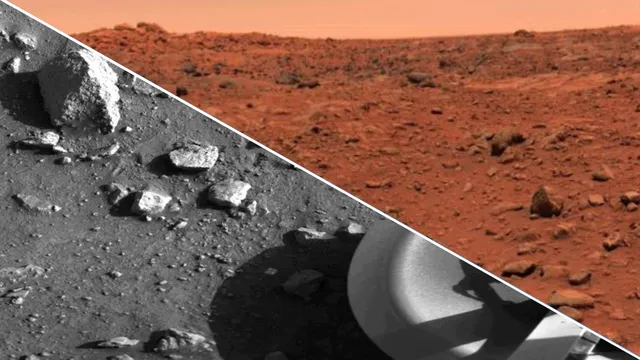
On July 20, 1976, NASA's Viking 1 successfully landed on Mars, marking a significant milestone in space exploration. This event occurred exactly seven years after the Apollo 11 moon landing and was initially intended to coincide with the U.S. Bicentennial celebrations on July 4, 1976. The landing site was chosen at Chryse Planitia, located north of the Martian equator, after a thorough search for a flat area suitable for touchdown. The spacecraft was programmed to take its first image just 25 seconds after landing, but mission controllers had to wait an additional 19 minutes for the confirmation signal to reach Earth, traveling over 212 million miles. When the first image finally appeared on monitors at NASA's Jet Propulsion Laboratory, it revealed a rocky surface with dust and pebbles, providing humanity with its first view from the surface of another planet.
The Viking mission consisted of two landers and two orbiters, with Viking 1 being joined by Viking 2 six weeks later, which landed in Utopia Planitia. The orbiters played a crucial role in mapping Mars and relaying a wealth of data back to Earth, including over 52,000 orbital images and 4,500 photographs from the surface. Although the mission's primary goal was to search for signs of life, the official conclusion stated that no convincing evidence was found. However, some scientists have continued to debate whether one of the experiments conducted by Viking produced a genuine biological signal, while others argue that the experiments may have destroyed potential evidence of life.
The discoveries made by later missions, such as the detection of organic molecules by the Curiosity rover and the identification of perchlorate salts by the Phoenix lander, have prompted researchers to revisit the data collected by Viking. This ongoing investigation highlights the enduring mysteries surrounding the potential for life on Mars and the significance of the Viking missions in shaping our understanding of the planet. Viking 1 ceased communication in 1982, two years after Viking 2, due to a software error during an update. Despite its silence, Viking 1's legacy remains as it provided humanity with its first glimpse of another planet's surface and opened the door to future exploration.
The Viking missions were pivotal in advancing our knowledge of Mars and laid the groundwork for subsequent missions. The images and data collected have continued to inform scientific inquiry and exploration strategies, making the Viking missions a cornerstone of planetary science. As researchers analyze the findings from Viking alongside newer data, the quest to understand Mars and its potential for life continues to evolve, underscoring the importance of these early missions in the broader context of space exploration.