

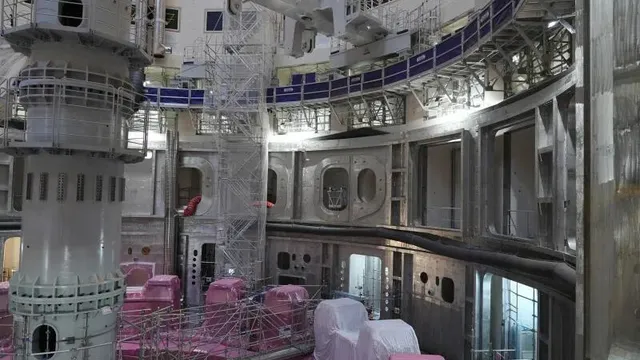
China set to lead the world in nuclear fusion with ambitious reactor plans
China set to lead the world in nuclear fusion with ambitious reactor plans
- China's BEST facility is scheduled for completion in 2027, contributing significantly to nuclear fusion efforts.
- Aiming for operational status by 2030, the China Fusion Engineering Demo Reactor represents the next phase of China's fusion ambitions.
- As nations invest heavily in fusion technology, competition is intensifying, making China's advancements pivotal to the future of energy.
Story
In recent years, China has ramped up its efforts in nuclear fusion technology, positioning itself as a serious contender in the global race for sustainable energy. Specifically, the project known as the Beijing Experimental Satellite Tokamak (BEST) is currently under construction and is scheduled for completion in 2027. This facility aims to act as a test bed for China’s next significant undertaking, the China Fusion Engineering Demo Reactor, which is projected to be operational by 2030. The development of a functional nuclear fusion reactor not only hinges on technological innovation but also requires significant financial backing and a robust industrial supply chain. To date, Chinese authorities have made substantial investments and set clear research priorities to ensure the success of their fusion ambitions. These initiatives are pivotal in cultivating the necessary expertise among scientists and engineers in the country, which involves extensive collaboration between government, research institutions, and industry. As the global landscape for fusion energy shifts, numerous startups worldwide are competing and have collectively raised $15 billion to develop various innovative fusion technologies. While companies in the United States claim that they could achieve net energy from fusion by the early 2030s, China's plans align closely with this timeline as well. With ongoing investment and policy support, particularly emphasized in the 15th Five-Year Plan, Chinese scientists are making careful strides toward realizing their fusion goals. At BEST, experts are working towards achieving self-sustaining burning conditions by fusing the isotopes deuterium and tritium, both of which are integral to nuclear fusion. Deuterium can be extracted from water, making it an accessible and relatively inexpensive fuel source. Moreover, research at the Comprehensive Research Facility for Fusion Technology, nicknamed Kuafu, complements the advancements at BEST, focusing on material development and other components essential for upcoming fusion systems. With its ambitious agenda, China aims to become a leader in the fusion energy sector, indicating that the pursuit of sustainable energy is more crucial now than ever before.
Context
In recent years, the investment in fusion energy projects worldwide has surged significantly, driven by the growing need for clean and sustainable energy sources to combat climate change and reduce our dependence on fossil fuels. Fusion energy, the process that powers the sun and stars, offers the potential for nearly limitless energy without the dangerous waste associated with nuclear fission. The allure of fusion lies in its safety, sustainability, and the abundance of lithium and hydrogen fuels required for the reaction, which can be sourced from seawater and lithium-bearing minerals. As nations seek to meet ambitious decarbonization targets, funding and research commitments to fusion projects have become more robust and widespread, fostering optimism for breakthroughs in this field. Key players in the fusion energy landscape include both governmental initiatives and private enterprises. Major government-led projects such as ITER (International Thermonuclear Experimental Reactor) in France, which aims to demonstrate the feasibility of fusion energy on a commercial scale, have seen continued investment from multiple countries. In parallel, a wave of private companies has emerged, spurred by advancements in technology and growing investor interest. Companies like TAE Technologies, Helion Energy, and Commonwealth Fusion Systems are developing innovative approaches that could accelerate the timeline to practical fusion energy and attract significant venture capital funding. This shift towards commercialization highlights a critical transition in public perception of fusion, moving it from a long-term experimental endeavor to a more actionable business opportunity. The global fusion energy market has expanded not only in terms of funding but also collaborations between nations, laboratories, and industries. The successful development of fusion energy systems is seen as a prerequisite for achieving global energy security and sustainability. Several countries including the United States, China, and members of the European Union are diversifying their funding strategies by involving the private sector in fusion research. These collaborative models help share risks and accelerate technological advancements by combining resources, expertise, and infrastructure. As a result, the pace of research is quickening, with shared discoveries potentially paving the way for a new era of energy production. Despite the optimistic outlook, significant technical challenges remain before fusion can be implemented widely. Achieving a net-positive energy output—where the energy produced exceeds the energy consumed in sustaining the fusion reaction—has not yet been realized. Nevertheless, with growing investments and dedication from researchers, the timeline for functional fusion power plants is gradually being shortened. Various estimates suggest that we could see operational fusion reactors or prototypes within the next two to three decades if current trends persist. This urgency highlights not only the potential of fusion energy as a future energy source but also its importance as part of a balanced energy portfolio that could ultimately assist in mitigating climate change.


