

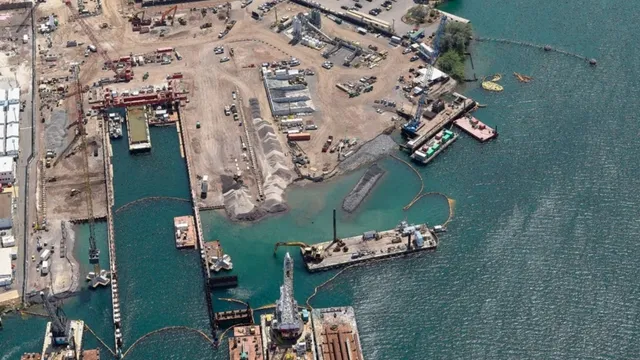
Navy builds new dry dock to support advanced submarines at Pearl Harbor
Navy builds new dry dock to support advanced submarines at Pearl Harbor
- A state-of-the-art dry dock project at Pearl Harbor began in August 2023, involving a significant financial investment.
- The new dry dock will replace a facility from 1942 and is designed to support advanced nuclear submarines.
- This initiative reflects the U.S. Navy's commitment to addressing aging infrastructure and enhancing strategic naval capabilities.
Story
The U.S. Navy is embarking on a significant construction initiative at Joint Base Pearl Harbor-Hickam, located in Hawaii. This project, which commenced in August 2023, involves the creation of a state-of-the-art dry dock specifically designed to accommodate the Navy's most advanced nuclear submarines. Replacement of an antiquated dry dock that dates back to 1942, this new facility represents a $3.42 billion investment in maintaining the Navy's submarine fleet. The construction, marked by a traditional Hawaiian blessing, showcases the Navy's commitment not only to modernization efforts but also to respecting local customs and the cultural significance of the base. The necessity for this upgrade lies in the shifting global naval power dynamics, particularly in response to China's expansion of its naval fleet and military capabilities in the Pacific. The readiness and resilience of the U.S. submarine fleet, which is heavily based at Pearl Harbor, are crucial for maintaining a strategic advantage in the face of evolving security challenges. Aging infrastructure has prompted this overhaul, which is part of a broader multi-year Navy initiative aimed at addressing these concerns. Dry Dock 5, once operational, is expected to play a vital role in servicing Virginia-class submarines and future classes for the next 150 years. As the construction progresses, notable figures from the Navy have conducted site inspections. Recently, Admiral Daryl Caudle, Chief of Naval Operations, toured the construction site and witnessed the transportation of large concrete and steel components that will form part of the dock’s structure. The project is not just a logistical endeavor but also a testament to the functionality and readiness of the Navy's facilities in Hawaii, which have historical significance dating back to the surprise attack that led America into World War II. Furthermore, key leaders have praised the efforts at Pearl Harbor, emphasizing the importance of modernizing critical shipyard facilities. Captain Chris Coggins, commanding officer of Pearl Harbor Naval Shipyard, articulated the mission to enhance key facilities mutually beneficial for both national defense and local economic interests. The completion of state-of-the-art Dry Dock 5 is scheduled for 2027. As the Navy prepares to transition between retiring submarine classes and new technological advancements, this facility will play an instrumental part in ensuring the operational readiness of America’s naval forces in the turbulent Pacific region.
Context
The impact of submarine technology on naval security has been profound, shaping modern warfare and international relations. Submarines, particularly nuclear-powered vessels, have changed the dynamics of naval capabilities. Their ability to operate undetected beneath the ocean's surface allows for stealthy reconnaissance missions and the capability to launch surprise attacks. This shift toward stealth has necessitated a re-evaluation of naval strategies among countries, making anti-submarine warfare (ASW) a priority in military planning. Nations are investing heavily in advanced ASW technologies, including sonar systems, unmanned underwater vehicles, and advanced research into submersible vehicles to counter the growing threat posed by stealthy adversarial submarines. The evolution of submarine technology has also introduced unique security challenges. The proliferation of advanced submarines, such as those armed with ballistic missiles, raises geopolitical tensions, particularly among rival nations. Countries that develop sophisticated submarine fleets often seek to assert dominance or expand their influence over contested waters, leading to an arms race among regional powers. Furthermore, the ability of non-state actors to potentially acquire or replicate submarine technologies poses an additional layer of risk, as these entities could exploit such capabilities for asymmetric warfare. This has compelled naval powers to adopt more robust surveillance and intelligence-gathering measures to monitor and respond to these threats effectively. Moreover, advancements in submarine technology have encouraged innovations in naval logistics and operational capabilities. Modern submarines are being designed with enhanced stealth features, improved endurance, and advanced weapon systems that enable them to engage in prolonged missions without detection. Additionally, many of today's submarines are equipped with advanced communication systems allowing for seamless coordination with allied forces, thus enhancing interoperability during joint operations. These enhancements not only optimize fleet readiness but also improve response times in conflict scenarios, thereby reinforcing naval security. In conclusion, submarine technology significantly influences global naval security landscapes. The blend of stealth with enhanced capabilities creates both opportunities and challenges for national security strategies worldwide. While advanced submarines can serve as deterrents or power-projection assets, they also necessitate ongoing investments in countermeasures and strategic planning. Nations must remain vigilant, adapting to the challenges posed by evolving submarine threats, to ensure that their naval forces maintain superiority in a changing geopolitical environment.


