
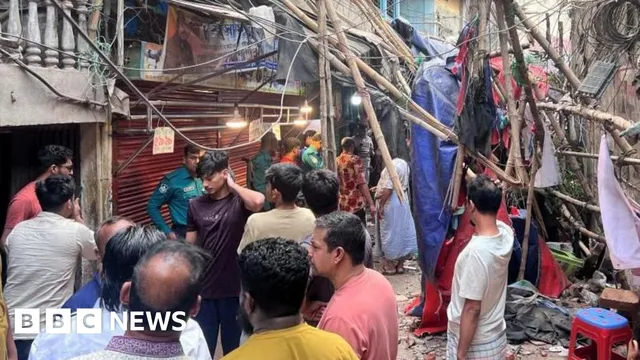
Five killed in devastating earthquake that strikes Bangladesh
- On November 21, a 5.7-magnitude earthquake struck Bangladesh, leading to panic and evacuations.
- The earthquake resulted in at least five deaths and around 100 injuries, with many affected being students and workers.
- The situation has led the government to increase rescue efforts and assess building safety in urban areas.
Story
On November 21, 2025, a significant earthquake with a magnitude of 5.7 struck Bangladesh, resulting in the loss of at least five lives and injuring approximately 100 individuals. The epicenter of the earthquake was located in Narsingdi, a district situated about 40 kilometers east of the capital city, Dhaka. The tremors were felt across the densely populated city, leading to widespread panic among residents, who quickly evacuated their homes in fear of collapsing buildings. Many of the injured included university students and factory workers, highlighting the diverse impact on the community. The government responded by closely monitoring the situation and initiating rescue operations for those affected by the disaster. Eyewitness accounts described how buildings shook violently and some collapsed altogether, causing injuries among pedestrians. Residents were particularly distressed, stating that they had never experienced such a severe tremor before, and many reported being trapped momentarily as furniture and debris fell around them. Meanwhile, in neighboring India, tremors were felt in eastern states bordering Bangladesh, but no immediate reports of damage were recorded there. This earthquake has raised concerns about building safety and preparedness for such natural disasters, particularly in urban areas where many structures are inadequately fortified. In the aftermath, authorities are likely to conduct thorough assessments of the damage and push for stricter building regulations to prevent future tragedies. The focus will be on rescuing those still trapped, treating the injured, and providing immediate aid to vulnerable populations affected by the quake. In the face of this disaster, the resilience of the affected communities will be tested as they begin the long process of recovery.
Context
Earthquakes are a significant geological hazard in Bangladesh, given its location on the boundary of two major tectonic plates—the Indian and Eurasian plates. This positioning makes the region susceptible to seismic activity, which can cause considerable damage to infrastructure, leading to loss of life and economic disruption. The capital Dhaka and other densely populated areas are particularly vulnerable due to poorly constructed buildings and inadequate urban planning. Historical data reveals that Bangladesh has experienced several devastating earthquakes, with the most notable being the 1906 Dhaka earthquake, which resulted in extensive destruction and numerous fatalities. The recurring concerns regarding seismic risks spotlight the urgent need for improved building standards and disaster preparedness in the region to minimize the impact of future earthquakes. Furthermore, the socio-economic consequences of earthquakes in Bangladesh are profound. The disruption caused by significant seismic events not only affects immediate livelihoods but also hampers long-term development efforts. Many communities depend on agriculture, which can be severely affected by earthquakes that destroy farmland or infrastructure such as irrigation systems and transportation networks. The economic repercussions include not just reconstruction costs but also lost productivity and increased poverty levels among affected populations. The impact is especially severe in underprivileged regions where resources for recovery are limited. The government's response to earthquake threats involves both mitigation and preparedness strategies. Initiatives have been launched to enhance the resilience of buildings and infrastructure by adopting earthquake-resistant designs and improving material standards. Additionally, awareness campaigns and training programs have been implemented to educate communities about earthquake safety measures, emphasizing the importance of emergency preparedness. However, challenges remain in enforcing building codes and ensuring compliance, especially in informal settlements where regulations may not be strictly followed. In conclusion, the threat of earthquakes in Bangladesh poses critical challenges that require a multi-faceted approach for effective management. It is crucial for the government, along with local and international organizations, to invest in disaster risk reduction strategies, improve infrastructure resilience, and enhance community preparedness. With the appropriate measures in place, it is possible to not only save lives but also protect the socio-economic fabric of the nation, ensuring that communities can recover more rapidly from future seismic events.
