

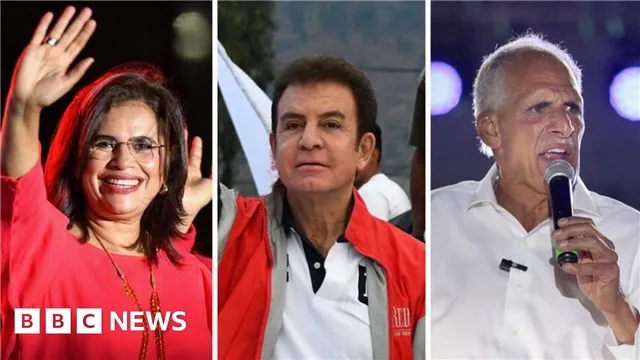
Trump warns Honduras of funding cuts if Asfura loses election
Trump warns Honduras of funding cuts if Asfura loses election
- Honduras held presidential elections on November 30, 2025, with significant external influence from the U.S.
- Donald Trump threatened aid cuts if Nasry Asfura loses, illustrating U.S. interests in the election outcome.
- The close race between candidates has raised concerns about potential electoral fraud and post-election unrest.
Story
Honduras held its presidential elections on November 30, 2025, amid significant political tension and external influence. The election was seen as a three-way race, featuring former defense minister Rixi Moncada from the left-wing Libre party, TV host Salvador Nasralla from the centrist Liberal party, and businessman Nasry "Tito" Asfura from the right-wing National Party. Key to the election dynamics was U.S. President Donald Trump's endorsement of Asfura, accompanied by warnings of severe repercussions, including funding cuts, should Asfura fail to win. Trump's involvement marks ongoing U.S. interest in Latin American politics, particularly regarding allies and adversaries in the region. With roughly 57% of the votes counted, early results indicated a close contest, with Asfura leading by only a few hundred votes over Nasralla. Amid concerns over potential electoral fraud, accusations of collusion from the ruling party and the opposition heightened fears of post-election unrest. Ana Paola Hall, the president of the National Electoral Council, appealed for calm while election authorities assured the public that the counting would continue, although technical issues hampered the progress. Salvador Nasralla, previously claiming an election was stolen in 2017, now finds himself narrowly trailing Asfura, while Rixi Moncada alleged Trump's meddling as interventionist, targeting a shift away from the rulership of the Libre party. Trump's rhetoric, describing potential consequences like "hell to pay" if results were altered, illustrates the stakes not only for Honduras but for U.S. foreign policy in Central America, particularly in combating drug trafficking and political corruption. As the election unfolded, it became clear that the outcome could have substantial implications for U.S.-Honduran relations. Trump's intentions towards Honduras echo broader strategies in Latin America to reshape leadership influenced by U.S. interests, particularly as tensions rise involving regional actors like Venezuela. Historical context reflects a troubled relationship with former Honduran President Juan Orlando Hernández, recently sentenced in the U.S. for drug trafficking, and how that legacy might affect current elections. The fear of post-election violence looms, reminiscent of the turmoil following the contentious 2017 elections, as election results approach finalization amidst accusations of manipulation and external pressures.
Context
The influence of Donald Trump on Central American elections has emerged as a crucial aspect in understanding the political landscape of the region. Trump's presidency marked a shift in U.S. foreign policy, particularly in relation to Latin America. His administration focused on curbing immigration from Central America and implementing policies that directly affected the governance and electoral processes in countries such as Guatemala, Honduras, and El Salvador. The approach taken by the Trump administration was characterized by a blend of rhetoric and actions aimed at stabilizing the region, ostensibly to prevent migration but also to bolster leaders who aligned with his views and served U.S. interests. This dynamic has led to an intricate interplay between U.S. policy and local electoral outcomes, with significant repercussions for democratic processes in the region. During Trump's presidency, many Central American leaders who had close ties to the United States were emboldened by the White House's support. The endorsement of specific candidates or political parties often translated into enhanced visibility and legitimacy on the local stage. For example, leaders like Juan Orlando Hernández of Honduras and Alejandro Giammattei of Guatemala benefited from Trump's backing, which translated into financial aid and support in exchange for their cooperation on immigration and drug trafficking issues. This kind of support, however, raised concerns regarding democratic integrity, as it sometimes involved overlooking human rights abuses or electoral fraud in favor of geopolitical interests. Such support from Trump’s administration shaped the electoral context, influencing not just current elections but sowing the seeds for political polarization and resistance against opposition candidates. Moreover, the rhetoric surrounding immigration played a pivotal role in shaping public sentiment in Central America, impacting voter behavior and the prioritization of political issues. Trump's aggressive immigration stance amplified fears of external threats, leading to the rise of populist leaders who could appeal to nationalistic tendencies among voters. This reshaping of political discourse contributed to the marginalization of progressive and democratic forces within these countries, which traditionally focused on social justice, anti-corruption, and human rights. The alliance between certain Central American governments and the Trump administration further led to contentious political climates, where elections became battlegrounds not only for governance but also for the soul of democracy in the region. Looking forward, the aftermath of Trump’s influence continues to resonate as Central America navigates its political future. The consequences of the relationships forged during his administration are complex and multifaceted. As political landscapes adapt post-Trump, Central American countries must contend with the legacies of decisions made during those years. This includes addressing outstanding issues such as corruption, economic inequality, and human rights, which were often sidelined in the pursuit of policies favored by the Trump White House. Consequently, the interplay between U.S. foreign policy and local electoral processes will remain critical for the stability and democratic advancement of Central America as stakeholders reassess their positions in light of changing political tides in the United States.


