

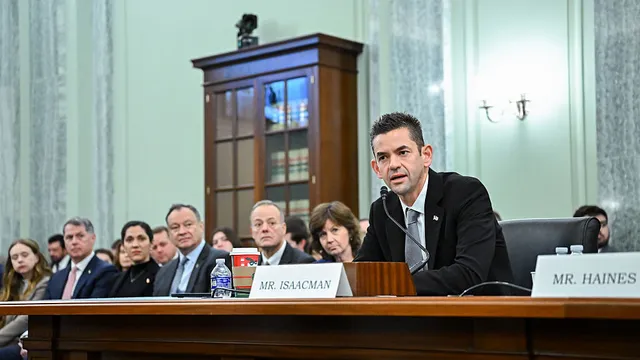
Jared Isaacman pushes for NASA leadership amid renewed Senate hearing
Jared Isaacman pushes for NASA leadership amid renewed Senate hearing
- Jared Isaacman has been renominated by President Donald Trump to lead NASA after his initial nomination was withdrawn.
- During a Senate hearing, Isaacman emphasized the importance of swift action for U.S. leadership in space exploration.
- The competition for lunar landing contracts is intensifying, with Isaacman advocating for collaboration with whichever company can deliver U.S. astronauts to the moon.
Story
In a recent Senate hearing, Jared Isaacman, a billionaire entrepreneur and spaceflight participant, reappeared before the U.S. Senate's Commerce, Science and Transportation Committee as part of his renewed challenge for leadership of NASA. This hearing, which took place in Washington, occurred eight months after Isaacman's first nomination, which was unexpectedly withdrawn by then-President Donald Trump. Isaacman's nomination was reintroduced following a controversy involving Trump's falling out with Elon Musk, founder of SpaceX, a company closely tied to NASA's ambitions. Isaacman emphasized the urgency for the U.S. to maintain its position as a leader in space exploration, specifically citing initiatives aimed at returning astronauts to the moon. Isaacman articulated the critical timeframe for the Artemis program, which aims to send human crews back to the moon for the first time since the Apollo missions. According to him, early next year is when NASA plans a lunar flyaround, though this mission won’t involve a landing. Isaacman warned of the risks of falling behind in the space race, particularly against China, and highlighted the broader implications such delays could have on the geopolitical balance of power. He insisted that prompt action is necessary to ensure that the U.S. remains the leader in space endeavors, asserting that hesitance now could have long-lasting consequences. During the hearing, Isaacman presented both lunar and Mars exploration as his top priorities for NASA. The senator leading the committee, Ted Cruz, supported Isaacman's assertive approach and echoed the sentiment about the U.S.’s need for decisive action in space. Cruz remarked that Isaacman's testimony felt reminiscent of his previous nomination hearing, indicating a sense of déjà vu. Part of the discussion included the competitive landscape of lunar landers, as Isaacman backed Transportation Secretary Sean Duffy's recent decision to reopen the contract for lunar landers under NASA's Artemis program. The original contract went to SpaceX with the Starship program, but competition has intensified as Blue Origin, led by Jeff Bezos, is also vying for the opportunity to provide lunar landing capabilities. Isaacman assured the Senate committee of NASA's intention to partner with whichever company can first ensure the safe delivery of U.S. astronauts to the lunar surface. Notably, Isaacman financed his own previous spaceflights, creating a strong personal stake in advancing commercial and governmental space endeavors.
Context
The impact of the space race on US-China relations is a multifaceted topic that symbolizes broader geopolitical dynamics and technological competition. The space race originally occurred during the Cold War, primarily involving the United States and the Soviet Union. However, as China's space capabilities evolved, particularly in the 21st century, it began to play an increasingly prominent role in the dynamics of international space exploration and technology. The U.S. perceived China's advancements in space, especially after the successful launch of its crewed space missions and its ambitions for lunar exploration, as both a challenge and an opportunity for strategic engagement and cooperation. Historically, the space race incited an atmosphere of rivalry, leading to significant investments in research, technology, and education in both the United States and China. Following the normalization of diplomatic relations in the 1970s, both nations have experienced periods of collaboration and contention. The U.S. initially welcomed China's interest in space science and technology, leading to cooperative agreements in the 1990s aimed at enhancing mutual interests in science and technology. However, as China developed its capabilities, the U.S. government grew increasingly cautious about potential military applications of China’s space program, leading to restrictions on joint collaborations, especially in sensitive technologies. In recent years, the stakes have escalated as both nations vie for leadership in space technology and exploration. The National Aeronautics and Space Administration (NASA) and the China National Space Administration (CNSA) have demonstrated contrasting approaches; while NASA often emphasizes international partnerships and transparency, China's space program is often seen as more centralized and closely tied to its national security objectives. The resultant tensions have included debates over space debris, satellite communications, and lunar mining rights. The competitive narrative surrounding space exploration between the U.S. and China is frequently viewed through the lens of national prestige and technological autonomy. As the world moves further into the era of space exploration, the implications of the U.S.-China space race are profound. It affects not just their bilateral relations but also global governance in space activities. The potential for collaboration remains; joint ventures in scientific research and exploration may help reduce tensions and build trust. However, geopolitical rivalries could hinder progress, framing space exploration as a battleground for technological supremacy rather than a platform for international cooperation. Thus, managing the competing interests of both nations will be crucial in shaping a peaceful and productive future in outer space.


