

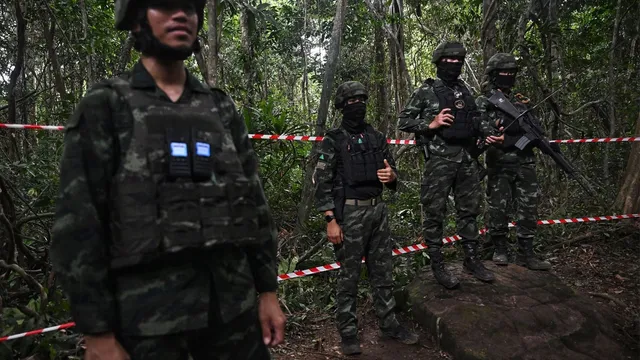
Thailand's military occupation displaces thousands of Cambodian families
Thailand's military occupation displaces thousands of Cambodian families
- Ongoing military incursions by Thailand are reportedly affecting civilian areas in Cambodia.
- Up to 4,000 Cambodian families remain displaced due to these incursions, despite a ceasefire agreement reached in December.
- The situation raises concerns about the fragile truce and the need for renewed dialogue between Cambodia and Thailand.
Story
Cambodia has raised alarm over ongoing military incursions by Thailand, which reportedly continues to occupy civilian areas within Cambodian territory. Spanning several border locations, this occupation has left as many as 4,000 Cambodian families displaced, with no clear return plan in sight. The incursions come on the heels of a December 2025 truce agreement, which aimed to bring an end to weeks of fierce fighting, yet the situation remains precarious and tense. Both Cambodia and Thailand have a long history of territorial disputes attributed to complicated historical and geopolitical factors. In December 2025, extensive clashes caused significant casualties, including over 100 fatalities and the displacement of more than half a million individuals across both nations. These confrontations marked yet another chapter in an enduring conflict that has persisted for over a century. Cambodian Foreign Minister Prak Sokhonn has been vocal about the need for dialogue and the re-establishment of a Joint Boundary Commission (JBC) for demarcation of the shared border. While Cambodia seeks resolution through bilateral discussions, the Thai government maintains that its troop presence does not constitute an occupation but is a matter of compliance with ceasefire agreements designed to de-escalate tensions. Thai officials have labeled Cambodia's accusations as unfounded, highlighting that their military adjustments are in line with previously agreed-upon measures. This response reflects the strong divergence in interpretations of the agreements reached, further complicating relations between the neighbors. As both countries grapple with the fallout from the conflict, the urgency to address the return of displaced civilians is paramount. It's crucial for Cambodian leadership to engage in constructive negotiations with Thai counterparts to ameliorate long-standing grievances and stabilize the region. With international mediation playing a role, including involvement from leaders like U.S. President Donald Trump and Chinese diplomats, there is potential for future resolutions to take shape, provided both sides demonstrate commitment to honoring truce agreements and prioritizing humanitarian concerns.
Context
The history of territorial disputes between Cambodia and Thailand has deep historical roots, influenced by territorial claims, historical empires, and colonial legacies. The most prominent dispute centers around the area surrounding the Preah Vihear Temple, a UNESCO World Heritage Site that epitomizes the complexities of national identity reflected in the geography of Southeast Asia. This temple, which stands on a cliff in the Dângrêk Mountains, has been at the center of contention since the colonial era, where its ownership was contested during the French and British colonial periods. In 1962, the International Court of Justice (ICJ) ruled in favor of Cambodia, recognizing its sovereignty over the temple, a decision that has not entirely settled the longstanding tensions between the two nations. Instead, it ignited a series of conflicts and confrontations as the interpretation of borders and land rights continued to be debated by both sides. The disputes were periodically aggravated by nationalistic sentiments that emerged in both countries, particularly during political transitions and times of national crisis. For instance, in the late 2000s, tensions flared due to border skirmishes and military deployments along the disputed areas. Both Cambodia and Thailand witnessed domestic political pressures, where nationalist rhetoric often played a decisive role in shaping public sentiment. In 2008, the Thai government’s decision to deploy troops to the area around Preah Vihear Temple exacerbated the situation, leading to clashes that resulted in casualties and highlighted the frail nature of bilateral relations. Such incidents reflect how historical grievances can intensify present-day conflicts, intertwining national identity with territorial integrity. Efforts to resolve these disputes have seen varying levels of diplomatic engagement, particularly through ASEAN frameworks, where both countries are members. However, the effectiveness of these interventions has often been complicated by internal political dynamics and external geopolitical factors, including involvement from global powers with interests in Southeast Asia. In recent years, initiatives aimed at fostering cooperation and preventing conflicts have emerged, focusing on creating joint development areas and increasing bilateral trade, yet substantial progress remains elusive. The economic repercussions of the territorial disputes, particularly in the context of tourism and investment, have also prompted calls for a more cooperative approach to the issues. Today, Cambodia and Thailand continue to navigate their fraught history as they seek a peaceful resolution to territorial disputes. The evolution of their relationship runs concurrently with regional developments and shifts in political power, demonstrating that territorial disputes are not merely historical remnants but live issues that impact contemporary societal and diplomatic relations. By comprehensively addressing the historic injustices, fostering mutual understanding, and utilizing a diplomatic approach, there remains hope that Cambodia and Thailand can ultimately reach a more enduring and peaceful resolution concerning their territorial disputes.


