NASA's TESS discovers new exoplanet 40,000 light-years away
science
ground breaking breakthrough
innovative

NASA's TESS discovers new exoplanet 40,000 light-years away

10
(Update: )
American space and aeronautics agency
all of the spacetime and its contents including the Earth, possibly being part of a multiverse, distinct from parallel universes if they exist
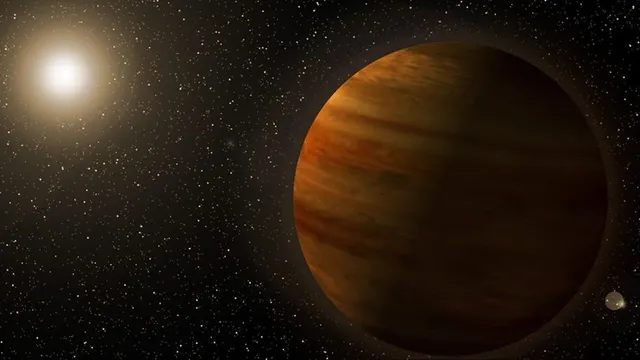
  • NASA's TESS identified a new exoplanet named Gaia23bra b, which is 1.6 times the size of Jupiter.
  • The planet orbits an orange dwarf star nearly 40,000 light-years away from Earth.
  • This discovery suggests that TESS may uncover more hidden microlensing planets in its data.
Share opinion
1

Story

In 2023, astronomers discovered a new exoplanet named Gaia23bra b, which is located nearly 40,000 light-years from Earth. This significant finding was made possible by NASA's Transiting Exoplanet Survey Satellite (TESS), which identified the planet despite it being 150 light-years outside its typical search radius. Gaia23bra b is 1.6 times the size of Jupiter and orbits an orange dwarf star that has about 80% of the Sun's mass. The discovery was initially noted by the European Space Agency's Gaia Telescope, which had limited observations of the planet. The TESS spacecraft's ability to monitor the same area of the sky with denser time coverage allowed researchers to detect additional features in the light curve caused by the planet. Mallory Harris, a Ph.D. candidate at the University of New Mexico, led a study that highlighted the importance of TESS in identifying such distant planets. The findings were published on July 1 in The Astrophysical Journal Letters, showcasing the potential for TESS to uncover more microlensing planets that were previously overlooked. Typically, TESS focuses on finding star-hugging transitioning planets, making the discovery of Gaia23bra b particularly rare. Diana Dragomir, a professor at the University of New Mexico and co-author of the study, noted that when TESS launched, no one anticipated it would be capable of finding such large planets at significant distances from their host stars. This discovery suggests that there may be many more microlensing planets hidden within TESS's data. Microlensing is a phenomenon that occurs when two stars align closely from our perspective, causing light from a more distant star to bend due to the warped space-time created by the nearer star's mass. Although microlensing has revealed less than 5% of known exoplanets, the discovery of Gaia23bra b indicates that TESS may be able to identify more planets through this method. NASA's upcoming Nancy Grace Roman Space Telescope is expected to further explore this area, aiming to reveal an estimated 1,000 microlensing planets and around 100,000 transiting planets when it launches later this year.

Context

The Nancy Grace Roman Space Telescope (Roman) mission is a groundbreaking initiative by NASA aimed at expanding our understanding of the universe. Scheduled for launch in the near future, the Roman telescope is designed to address some of the most pressing questions in astrophysics and cosmology. Its primary objectives include the investigation of dark energy, the study of exoplanets, and the exploration of the formation and evolution of galaxies. By utilizing a wide-field camera, Roman will be able to survey large areas of the sky, capturing data that will help scientists unravel the mysteries surrounding the accelerated expansion of the universe and the nature of dark energy, which constitutes a significant portion of the universe's total energy density yet remains poorly understood. In addition to its focus on dark energy, the Roman telescope will play a crucial role in the search for exoplanets. With its advanced imaging capabilities, it will conduct a survey of nearby stars to identify and characterize planets orbiting them. This will include the detection of transiting exoplanets, where the telescope will monitor the brightness of stars to identify periodic dips caused by planets passing in front of them. The data collected will not only enhance our knowledge of planetary systems but also contribute to the understanding of the conditions that may support life beyond Earth. The Roman mission is expected to significantly increase the number of known exoplanets, providing a wealth of information for future studies. Another key objective of the Roman mission is to investigate the formation and evolution of galaxies. By observing galaxies at various stages of their development, Roman will help astronomers understand how galaxies form, grow, and interact over cosmic time. The telescope's wide-field view will allow it to capture images of millions of galaxies, providing a comprehensive dataset for analyzing their structures and distributions. This information is vital for testing theories of galaxy formation and evolution, as well as for understanding the role of dark matter in shaping the universe. Overall, the Nancy Grace Roman Space Telescope represents a significant advancement in astronomical research. Its multifaceted mission objectives will not only deepen our understanding of dark energy and exoplanets but also enhance our knowledge of galaxy formation and evolution. As the mission progresses, the data collected by Roman is expected to lead to groundbreaking discoveries and insights, ultimately transforming our comprehension of the cosmos and our place within it.