

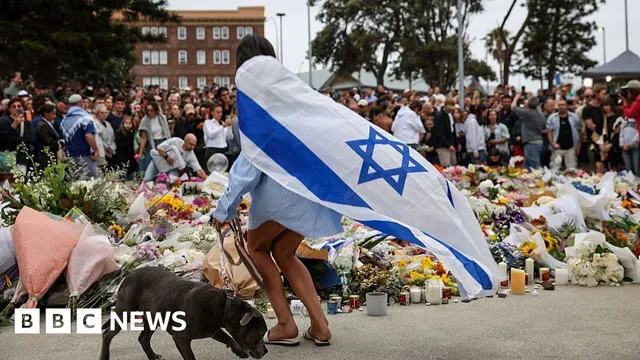
Bondi Beach attack leaves fifteen dead and shocks Australia
Bondi Beach attack leaves fifteen dead and shocks Australia
- On a Sunday evening at Bondi Beach, a father and son attacked a Hanukkah celebration, killing fifteen people.
- The attackers were linked to ISIS, prompting a re-evaluation of security measures for the Jewish community.
- The incident has sparked national debate over gun control and public safety in Australia.
Story
In a tragic incident at Bondi Beach, Australia, a father and son opened fire on families celebrating a Hanukkah event, resulting in the deaths of fifteen individuals and injuring over two dozen others. The attack, which occurred on a Sunday evening, has been described by law enforcement as an ISIS-inspired terrorist act. The gunmen, aged 24 and 50, were found with improvised explosives and homemade ISIS flags, raising concerns about their motivations and potential broader plots. Authorities are currently investigating their recent travels to the Philippines, where links to ISIS-aligned militant groups exist. The incident has provoked a strong public reaction regarding the security measures in place for the Jewish community in Australia, particularly in light of rising anti-Semitism. In critical condition are included ten of the injured, with three victims hospitalized as patients in a children's hospital. Ahmed al Ahmed, a Syrian-born fruit shop owner, heroically disarmed one of the shooters and sustained serious injuries in the process. His actions highlight the bravery amidst a chaotic and horrifying scene. In response to the attack, leaders across Australia have pledged to reconsider existing gun laws, prompting discussions about reform that could lead to the most significant changes since the 1996 Port Arthur massacre. This latest event serves as a painful reminder of the need for vigilant protection of communities against hate-fueled violence. As forensic teams analyze the items retrieved from the suspects, investigators are also reviewing digital records, travel history, and substantial seized documentation to uncover the full extent of the plot. While no additional attackers have been identified, the evolving situation illustrates the complex nature of domestic terrorism and the challenges faced by authorities in preventing such heinous acts.
Context
The report on ISIS presence in the Philippines elaborates on the impact of such extremist groups on the security landscape of the region. In recent years, the Philippines has faced challenges related to insurgency and terrorism, with ISIS affiliates emerging particularly in the southern regions, such as Mindanao. This report aims to analyze the statistics related to crimes attributed to ISIS and its affiliates, focusing on the implications for national security and the efforts of the Philippine government to combat these threats. The presence of ISIS in the Philippines is often characterized by localized radicalization and recruitment, leading to the establishment of cells operating under various names and ideologies influenced by ISIS. Crime statistics indicate a worrying trend of violence associated with these extremist groups. Reports from law enforcement and security agencies highlight an increase in armed encounters, bombings, and kidnappings linked to ISIS operatives. Notably, areas such as Marawi City experienced significant violence during the 2017 siege, which highlighted the capacity of ISIS to mobilize and enact coordinated attacks. The ongoing threat has implications not just for local communities but also for regional security in Southeast Asia. The Philippine government has implemented various counterterrorism strategies, including military operations and community engagement programs aimed at preventing radicalization and securing affected areas. The challenge in addressing the problem lies in the complex socio-economic and political landscape of the Philippines. Factors such as poverty, lack of education, and historical grievances can contribute to the vulnerability of individuals, particularly the youth, to radical ideologies. The government, along with international partners, has been focusing on not only military actions but also on rehabilitation and reintegration programs for former militants. These efforts aim to mitigate the recurrence of violence and foster community resilience against extremist influences. Moreover, the statistics surrounding ISIS-related crimes reflect broader regional trends, making collaboration with neighboring countries essential in addressing transnational terrorism. Information sharing, joint operations, and capacity-building are critical components of a sustained response to the ISIS threat. Understanding the dynamics of ISIS's presence in the Philippines is crucial for crafting effective policies and interventions to ensure the safety and security of the nation and its citizens. Continued vigilance and adaptive strategies will be necessary as ISIS may evolve and change tactics, necessitating a robust and multifaceted approach to counter this persistent danger.


