

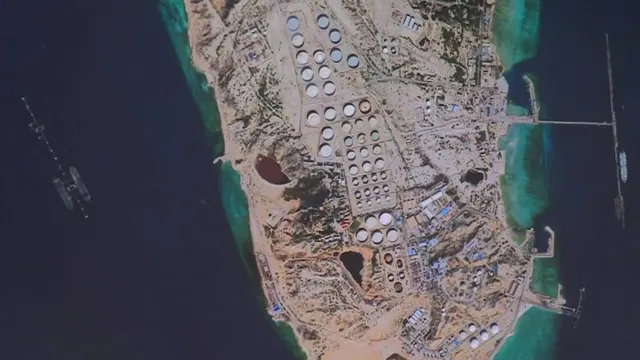
Iran maintains oil exports from Kharg Island amid escalating US strikes
Iran maintains oil exports from Kharg Island amid escalating US strikes
- The US targeted military installations on Kharg Island while avoiding damage to its oil export infrastructure.
- Kharg Island handles approximately 90% of Iran's oil shipments, crucial for its economy.
- Despite ongoing conflict, Iran successfully continues exporting oil from Kharg Island, raising concerns over global oil supply.
Story
Iran has been at the center of an escalating military conflict involving the United States and Israel, notably surrounding Kharg Island, a crucial oil export terminal. The conflict intensified after the US launched a significant bombing raid on March 14, 2026, targeting military installations on the island while notably sparing its vital oil infrastructure. Kharg Island serves as the main export terminal for nearly 90% of Iran's crude oil, thus playing a strategic role in Iran's economy, allowing it to export millions of barrels daily primarily to China. President Trump declared the strikes as a major military success while emphasizing the importance of not damaging the island's oil facilities, aware of the potential repercussions from China as a significant buyer of Iranian oil. Notably, Kharg Island has continued its operations under duress, exporting approximately 1.1 million to 1.5 million barrels per day since hostilities resumed, with records of high volumes of oil being shipped recently despite the strikes. Iran's government has made it clear that any damage to its oil infrastructure would trigger severe retaliation against military and energy interests linked to the US in the region. This critical situation underscores Iran's reliance on its oil exports for funding, particularly in light of the economic strain imposed by the ongoing conflict, and raises concerns about the stability of global oil supplies as more international attention is drawn to the conflict in the region.
Context
The U.S. military strategy in the Persian Gulf has long been characterized by a focus on deterrence and stability in a region that is vital to both American interests and global energy supplies. The Gulf states possess a significant proportion of the world’s oil reserves, making control of the region critical for economic stability and energy security. This strategic importance drives the U.S. to maintain a robust military presence, marked by naval fleets, air forces, and ground troops stationed in key locations. The United States seeks to deter aggression from regional powers, notably Iran, which has historically posed a challenge to U.S. interests and those of its allies through its military capabilities and proxy networks. As of 2023, continued tensions with Iran and the complexities of regional politics necessitate a flexible and adaptive military posture, capable of responding swiftly to emerging threats while fostering partnerships with Gulf Cooperation Council (GCC) countries. Central to the U.S. military strategy is the concept of forward presence. This includes the deployment of naval assets in the Arabian Gulf and the establishment of military bases in Qatar, Bahrain, and the UAE. These bases serve not only as operational hubs but also as platforms for joint exercises and interoperability among allied forces. The emphasis is on not just deterrence through presence but also on enhancing the defense capabilities of regional allies. As part of this strategy, the U.S. engages in arms sales and military training with Gulf states, helping them build up their own defense mechanisms against potential threats, particularly from missile attacks and asymmetric warfare tactics typically employed by Iran. In recent years, the U.S. military has evolving to address new security challenges beyond traditional state-versus-state confrontation. These include counterterrorism operations against groups such as ISIS and addressing the threat of drone warfare, which has proliferated in the region. The strategy embraces new technologies, including cyber capabilities, which have become essential for both defense and offense in modern warfare. Conducting operations against ISIS demonstrates the U.S.'s commitment to stability in the region, highlighting its role as a key security partner for Gulf states in countering terrorism and extremist ideologies. Looking forward, the U.S. military strategy in the Persian Gulf must adapt to an increasingly multipolar world. Relations with China and Russia are influencing regional dynamics, compelling the U.S. to reassess its strategy in the context of global geopolitical shifts. Future strategy may emphasize multilateral security frameworks that include not only traditional military partnerships but also engagement with other powers operating within the Gulf. Successfully navigating these complexities while maintaining robust relations with Gulf allies will be essential for ensuring U.S. influence and stability in this crucial region.


