

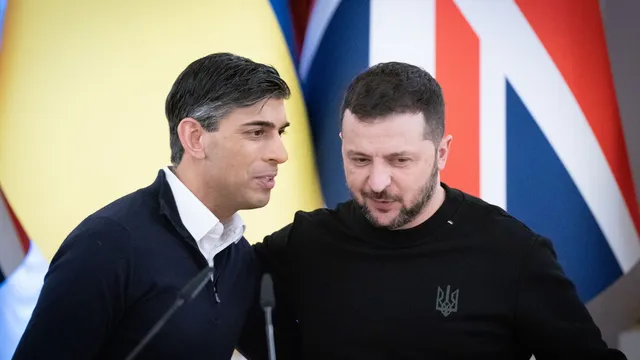
Zelenskyy announces meeting with Trump envoys to discuss Ukraine recovery plan
Zelenskyy announces meeting with Trump envoys to discuss Ukraine recovery plan
- A Ukrainian delegation will meet with American envoys in Geneva to prepare for more discussions with Russia.
- The meeting is part of a broader effort to discuss a potential recovery plan for Ukraine post-conflict.
- Ongoing military engagements and altitude attacks continue to shape the situation as Ukraine seeks to navigate the seventh year of the war.
Story
In Ukraine, on Thursday, a delegation headed by Rustem Umerov, the National Security and Defense Council Secretary, is set to meet with American envoys, including Steve Witkoff and Jared Kushner, in Geneva. This meeting occurs against the backdrop of ongoing conflict, as Russia's invasion of Ukraine enters its fifth year. Discussions will primarily focus on the details surrounding a potential postwar recovery plan and preparations for an upcoming trilateral meeting with Russian officials. Recently, the conflict has seen a notable pushback from Ukrainian forces along the eastern front, where they have made significant tactical gains, though they continue to face challenges due to troop shortages. Amid these developments, there have been ongoing tensions surrounding drone attacks by Ukrainian forces deep inside Russian territory, which have prompted discontent from the U.S., particularly concerning impacts on oil interests in Kazakhstan. Additionally, U.S. officials have expressed concerns about their increasing target list, including the recent attack on the Dorogobuzh fertilizer plant, which resulted in casualties. The strategy behind these actions is aimed at disrupting Russia's military plans during a crucial phase of the conflict as spring approaches, although the situation remains precarious, both for Ukraine and the wider geopolitical landscape.
Context
The historical context of Russia's invasion of Ukraine is deeply rooted in the complex interplay of national identities, geopolitical interests, and the legacy of Soviet influence in Eastern Europe. Following the collapse of the Soviet Union in 1991, Ukraine gained independence, yet the remnants of historical ties, cultural connections, and economic dependencies on Russia continued to shape its domestic and foreign policies. For many in Russia, particularly under President Vladimir Putin, Ukraine is seen not merely as a neighboring state but as a critical part of the Russian sphere of influence, intertwined with Russian identity and security concerns. This perspective has been exacerbated by NATO's eastward expansion, which Russia perceives as a threat to its national interests and security, particularly in the context of Ukraine's aspirations to align more closely with Western institutions. The turning point in this complicated relationship came in 2014 when Ukraine underwent significant political turmoil, notably the Euromaidan protests, which led to the ousting of the pro-Russian President Viktor Yanukovych. In response, Russia annexed Crimea, a move widely condemned by the international community as a violation of international law. This annexation was justified by Russia as a protective measure for ethnic Russians in Ukraine and was followed by pro-Russian separatist movements in the eastern regions of Donetsk and Luhansk, escalating the conflict into a broader war. The annexation of Crimea and the ensuing conflict highlighted the failure of diplomatic efforts and the deep mistrust that characterized Russia-West relations, setting the stage for further military engagements. Following the initial conflict and ongoing skirmishes in eastern Ukraine, Russia's military build-up on its western border in late 2021 signaled an alarming potential escalation. By early 2022, fears of a full-scale invasion became palpable as negotiations failed to resolve tensions. On February 24, 2022, Russia officially launched a large-scale invasion, citing the need to protect Russian speakers and combat alleged threats from NATO. This invasion represented not only a severe violation of Ukraine's sovereignty but also a significant moment in post-Cold War history, reflecting broader geopolitical shifts and the re-emergence of territorial aggression in Europe. Global reactions included sanctions against Russia, military support for Ukraine, and an unprecedented unity among NATO allies. As of 2026, the conflict has evolved, with continued engagements leading to significant humanitarian crises and a reshaping of global alliances and energy markets. The war has reinvigorated debates around military spending, defense capabilities, and the long-term security architecture in Europe. The historical context of Russia's invasion of Ukraine illustrates the pivotal role that national identity and geopolitical strategy play in international relations, underscoring how historical grievances and aspirations can lead nations into protracted conflicts. Understanding this backdrop is essential for comprehending the complexities of both current events and future developments in the region.


