

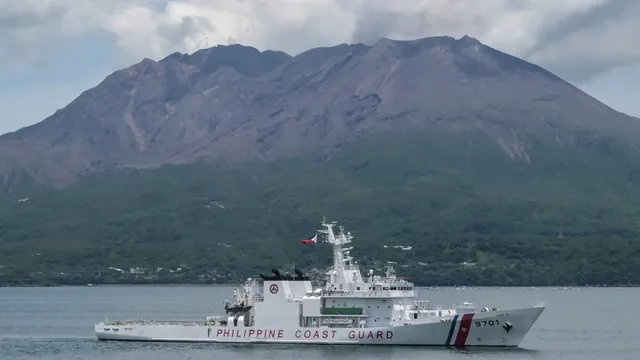
Philippines challenges China's maritime presence in contested waters
Philippines challenges China's maritime presence in contested waters
- The Philippine coast guard deployed its flagship to monitor Chinese maritime activity near Scarborough Shoal.
- China has intensified its patrols in the contested waters, claiming sovereignty over the majority of the South China Sea.
- This ongoing tension highlights the need for diplomatic and military actions to deter China's advances in the region.
Story
In recent developments in the South China Sea, the Philippines, a U.S. ally, has deployed its coast guard flagship to assert its sovereignty in disputed waters, particularly near Scarborough Shoal. This strategic move comes amidst ongoing tensions with China, which claims the majority of the South China Sea and has maintained a considerable maritime presence in these areas, particularly since it effectively took control of Scarborough Shoal in 2012. The presence of the Philippine coast guard aims to reaffirm the country's commitment to defending its territorial rights, particularly within its exclusive economic zone, which stretches 230 miles from its coastline under international law. China's actions have included frequent patrols around Scarborough Shoal, often resulting in standoffs with Philippine forces. This area, located roughly 120 miles west of Luzon, is a critical flashpoint for territorial disputes between the two nations. Despite a 2016 ruling by the Permanent Court of Arbitration that invalidated China's expansive claims and reaffirmed traditional fishing rights for both countries, the Chinese military and coast guard have continued to operate aggressively in the region. As part of its assertion of sovereignty, China has announced plans to establish a marine nature reserve around the Scarborough Shoal, raising concerns among neighboring countries about further encroachment into their maritime territories. The Philippines has responded to these incursions by monitoring Chinese vessels, confronting them during patrols, and enacting diplomatic measures to address international violations of its maritime rights. The United States, guided by its mutual defense treaty with the Philippines established in 1951, has pledged to uphold the Philippines' sovereignty. This commitment has been reiterated in recent statements, emphasizing that any armed attacks on Philippine forces or vessels in the region would activate U.S. mutual defense obligations. Following a series of military exercises and operations, including anti-submarine warfare drills involving the USS Nimitz carrier strike group, the U.S. has shown its support for its ally amidst escalating tensions in the area. The Philippine Coast Guard has characterized China's recent activities as illegitimate, underscoring recurring instances where Chinese vessels have refused to respond to lawful radio challenges from Philippine authorities. As both nations continue to assert their claims, the future of security and stability in the South China Sea remains uncertain, and heightened presence and military readiness are likely to persist around Scarborough Shoal.
Context
The South China Sea territorial dispute is a complex geopolitical issue involving multiple countries, primarily China, Vietnam, the Philippines, Malaysia, Brunei, and Taiwan. The contentious area is rich in resources, including fisheries and potential oil and natural gas reserves, and serves as a vital shipping route for global trade. Historical claims, stretching back for centuries, remain a primary source of contention, with China asserting a broad claim based on the so-called 'Nine-Dash Line.' This line encompasses an extensive portion of the South China Sea, leading to overlapping territorial claims with other nations that also lay claim to the Spratly and Paracel Islands. Each claim is bolstered by historical precedent, territorial water laws, and strategic military interests, creating a fraught atmosphere of nationalism and rivalry among the claimant nations. In recent years, heightened tensions have manifested in various forms, including military confrontations, diplomatic protests, and increased naval patrols by China and the United States. The United States, while not a claimant, has asserted its interest in freedom of navigation in the region, often conducting ''freedom of navigation operations'' close to areas claimed by China. This has led to confrontations at sea, with both sides accusing the other of provocative actions. Additionally, international law, particularly the United Nations Convention on the Law of the Sea (UNCLOS), is often invoked in negotiations. However, China does not recognize the 2016 ruling by the Permanent Court of Arbitration that invalidated its claims, further complicating diplomatic resolutions. The implications of these disputes extend beyond the immediate parties involved, affecting regional security and international relations. Nations in Southeast Asia feel the pressure to align either more closely with the United States for security guarantees or pivot towards China due to economic interdependence. For instance, countries like Vietnam and the Philippines have been engaging in joint military exercises with the United States while simultaneously negotiating economic partnerships with China. This balancing act highlights the broader implications of the territorial disputes, where local matters intertwine with global power dynamics influenced by superpowers' strategic interests. Efforts to resolve the disputes have included bilateral negotiations, regional forums, and multilateral talks, but a comprehensive and lasting solution remains elusive. The Association of Southeast Asian Nations (ASEAN) has sought to mediate discussions, emphasizing the need for a Code of Conduct in the South China Sea to ensure peaceful resolution of conflicts. However, the effectiveness of ASEAN in brokering peace is often questioned due to differing national interests and the reluctance of member states to confront China directly. As the situation continues to evolve, the risk of military escalation remains a significant concern, emphasizing the need for continued dialogue and diplomatic engagement to navigate the complex landscape of the South China Sea disputes.


