

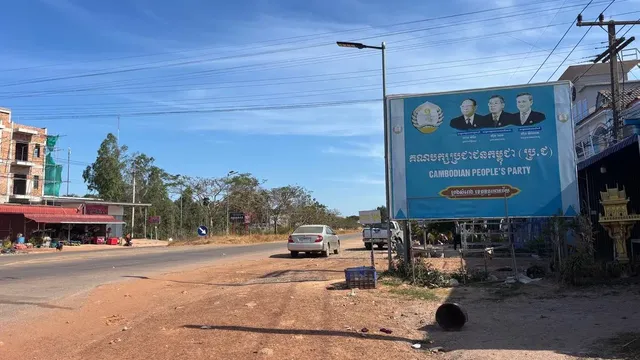
Thailand launches air strikes against Cambodian scam sites
Thailand launches air strikes against Cambodian scam sites
- On December 8, 2025, Thailand launched air strikes on alleged online scam compounds in Cambodia, causing significant destruction.
- Many Cambodians living near the border fled their homes amid the violence, and reports indicated casualties among local workers.
- Although a ceasefire was established on December 27, lingering fear and distrust among the residents of O'Smach continue to shape their lives.
Story
Cambodia's O'Smach, a border town, has faced severe upheaval following air strikes by the Thai military on December 8, 2025. The offensive targeted online scam compounds, resulting in residents fleeing amid intense shelling that showcased the tensions at the border. Despite Thailand's claims that the military action aimed to combat global crime and restore regional stability, fear persists within the Cambodian community regarding the safety and potential repercussions of ongoing tensions. A ceasefire agreement between Cambodia and Thailand was reached on December 27, but many locals remain distrustful and on edge, fearing future violence. Local accounts describe the aftermath of the strikes, revealing a community grappling with loss and uncertainty. Cambodian workers, previously employed at the scam compounds, reported chaotic evacuations and the tragic loss of coworkers amidst the attacks. One witness recounted a horrifying scene in which they discovered a deceased Cambodian security guard, highlighting the human cost of this conflict. Workers have expressed mixed feelings about their employers and reported that the foreign workers were often kept in the dark about the true nature of their operations, raising further concerns about exploitation and transparency. As residents of O'Smach slowly begin to return to their homes, they confront a landscape of destruction and lingering fear. The situation remains precarious, with Cambodia's Foreign Minister alleging that Thai military forces continue to occupy parts of Cambodian territory despite the ceasefire. This ongoing military presence is a focal point of anxiety for O'Smach's residents, who do not trust Thai soldiers and fear that their community could once again become a target. In conclusion, the events surrounding the air strikes have left an indelible mark on O'Smach and its residents. The fragile ceasefire has not quelled fears of further conflict, and the community's readiness to confront their circumstances reflects a widespread anxiety about their future safety and stability in this border region. As discussions about crime suppression and military accountability evolve, the reality on the ground paints a picture of a community caught in the crossfire, navigating both the immediate impacts of violence and the long-term implications of strained international relations.
Context
The history of the Thailand-Cambodia border conflict has been marked by territorial disputes, nationalist sentiments, and cultural tensions, particularly surrounding the ancient site of Preah Vihear Temple. Situated on a cliff in the Dângrêk Mountains, the temple has been at the center of a prolonged disagreement between Thailand and Cambodia regarding its sovereignty. The conflict can be traced back to the colonial era when the borders were drawn by French and British colonial powers. The dispute intensified when the International Court of Justice (ICJ) ruled in 1962 that the temple belonged to Cambodia; however, Thailand has contested this ruling, leading to intermittent clashes and a complex relationship between the two nations. In recent decades, the conflict has been characterized by fluctuations of violence, including military skirmishes and protests, particularly around the 2008 UNESCO World Heritage designation of Preah Vihear Temple. This designation ignited national pride in both countries and exacerbated historical grievances. The Thai military's encroachment into what Cambodia claimed was its territory led to armed confrontations, highlights of which include the violent clashes in 2011 that resulted in fatalities and displaced civilians. Both governments have sought to manage the crisis through diplomatic channels, although nationalist rhetoric and public sentiment often hampered efforts for a peaceful resolution. Regional and international implications have arisen from this dispute, impacting ASEAN relations and the geopolitical balance in Southeast Asia. The conflict has highlighted the broader challenges faced by the ASEAN community in addressing historical disputes within a framework of regional cooperation. External actors, including China and the United States, have shown interest in the region, influencing negotiations and providing support to either nation during times of conflict. This external factor has often complicated the situation, as different geopolitical interests intersect with local disputes. Despite occasional progress, including recent attempts to demilitarize the border area and improve bilateral relations, the Thailand-Cambodia border conflict remains unresolved. The historical narrative continues to evolve, as both nations grapple with their respective national identities and the legacies of colonialism. Future discussions surrounding the border, cultural heritage, and shared history will be crucial in facilitating a sustainable resolution, aimed at fostering mutual understanding and cooperation rather than continued discord.


