
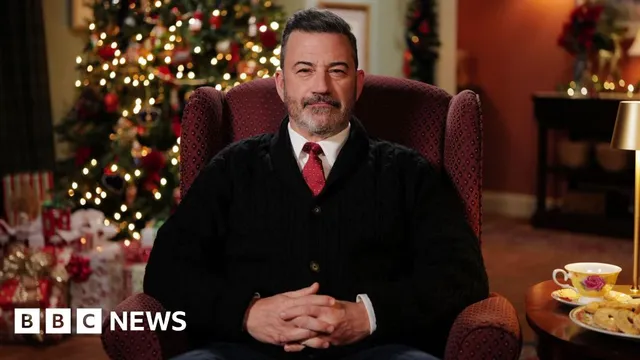
Jimmy Kimmel highlights growing fascism in alternative Christmas message
- Jimmy Kimmel will present an Alternative Christmas Message on Channel 4, focusing on the state of free speech and issues of fascism.
- His address comes after a year marked by political discourse and controversy surrounding his comments that led to his show being temporarily suspended.
- The broadcast tradition, established in 1993, allows various hosts to offer alternative perspectives to the monarch's annual Christmas message.
Story
In the United Kingdom, American late-night host Jimmy Kimmel is set to deliver the annual Alternative Christmas Message on Channel 4 on Christmas Day, December 25, 2025. His address will address various social and political issues, particularly reflecting on the past year's events that have significant bearing on free speech and fascism. Kimmel’s remarks come in the wake of increased scrutiny around these issues, especially given the politically charged atmosphere in the United States and the controversy surrounding his show’s temporary suspension earlier in the year. Kimmel has been a public critic of former President Donald Trump, and his message is expected to resonate with those concerned about the current political landscape. His statement indicating that 2025 has been a particularly good year for fascism reflects a growing sentiment among some observers who are alarmed about authoritarian trends in several democratic countries. With Kimmel’s sharp wit and humor, viewers can expect a blend of critical reflection and levity in his message. Past recipients of the Alternative Christmas Message have included various public figures from different walks of life, and Kimmel's choice to engage with pressing global issues showcases the evolving nature of this holiday tradition. The British Channel 4 network has embraced this innovative format since its inception in 1993, aiming to offer an alternative perspective to the sovereign's Christmas broadcast, which is traditionally more solemn. Kimmel's history in the entertainment industry has often intersected with public discourse on governance and personal freedoms, allowing him to contribute uniquely to this format. His recent suspension highlighted the ongoing debates surrounding censorship, freedom of expression, and the implications of media narratives in shaping public opinion during times of political upheaval. The stage is set for Kimmel to deliver a poignant and thought-provoking message as audiences reflect on the implications of such a politically charged year.
Context
Fascism in America has emerged as a critical subject of examination in recent years, particularly in the context of ongoing socio-political changes by December 2025. The resurgence of nationalist sentiments, the rise of far-right groups, and the growing acceptance of authoritarian rhetoric have raised alarms among scholars, political analysts, and the general populace. Understanding the contours of this phenomenon requires not only a historical perspective but also a keen awareness of contemporary developments that align with fascist ideologies. While the United States has a storied history of resisting authoritarianism, signs of fascism's infiltration into mainstream politics demand close scrutiny and address significant implications for democratic institutions and civil liberties. In assessing the landscape, it is essential to recognize the characteristics commonly associated with fascism, including extreme nationalism, disdain for international norms, the devaluation of pluralism, and the promotion of a singular, often exclusionary identity. Politically, figures associated with this ideology have capitalized on societal fears and economic disenfranchisement, fostering a narrative that blames societal issues on targeted groups. These elements have been exacerbated by social media, where disinformation and incendiary rhetoric can spread rapidly, mobilizing support for regressive policies and undermining trust in democratic processes. The tactics employed by these groups often involve leveraging political power to erode the rule of law, manipulate electoral processes, and engage in propaganda, further blurring the lines of democratic governance. Moreover, the cultural ramifications of these movements must also be considered. Normalizing fascist ideologies manifests not only in political discourse but also permeates cultural narratives and debates around identity and belonging. Many Americans have experienced growing divides within communities, with groups increasingly polarized along ideological lines. Intersectionality and the recognition of diverse voices within the American political landscape are often sidelined in favor of monolithic representations that align with fascist rhetoric. Grassroots movements advocating for inclusivity and social justice face significant pushback, which further illustrates the tension between established democratic ideals and emerging authoritarian practices. To combat the rise of fascism, a multifaceted response is necessary. This includes fostering critical media literacy, promoting civic engagement, and ensuring that democratic institutions remain robust and accountable. Educational systems must play a vital role in shaping a politically aware citizenry, capable of recognizing the dangers posed by fascistic ideologies. Dialogue across political divides is imperative, as is the reaffirmation of core democratic values that uphold human dignity and pluralism. The challenge posed by fascism in America is not insurmountable, but it requires vigilance, solidarity, and a commitment to defend democracy against the forces that threaten to dismantle it.
