

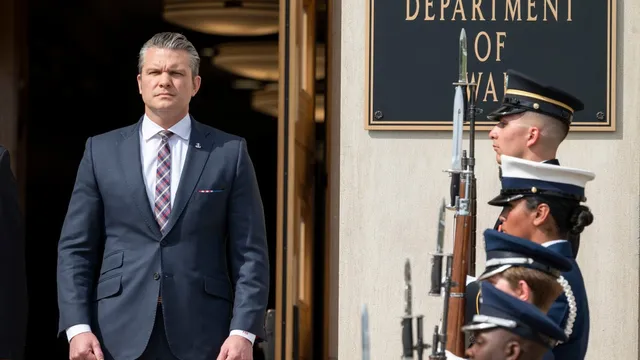
Representative Yassamin Ansari launches impeachment articles against defense secretary
Representative Yassamin Ansari launches impeachment articles against defense secretary
- In April 2026, Representative Yassamin Ansari introduced articles of impeachment against Secretary of Defense Pete Hegseth.
- The articles include allegations of unauthorized war, abuse of power, and civilian casualties related to U.S. military actions in Iran.
- The impeachment measure is unlikely to pass in the Republican-led House, highlighting political tensions over military conduct.
Story
In the United States, on Wednesday, April 15, 2026, Democratic Representative Yassamin Ansari filed six articles of impeachment against Secretary of Defense Pete Hegseth. The measure was introduced due to Hegseth's actions during the ongoing U.S. war in Iran, where his alleged misconduct included unauthorized disclosures of classified information, unlawful military strikes resulting in civilian casualties, and abuse of power. These allegations are severe, particularly as they implicate the safety of U.S. troops and seemingly violate both constitutional and international laws. Ansari's articles of impeachment gained the support of a dozen Democratic colleagues, which indicates a significant partisan divide regarding the conduct of Hegseth and the administration's military actions. Notable articles include claims of an unauthorized war against Iran, violations of armed conflict law, and reckless handling of classified information. These actions, according to Ansari, undermine the trust of Congress and the public in the military leadership. The articles also draw attention to a highly publicized incident involving an airstrike on a girls' school in Minab, Iran, resulting in numerous civilian deaths, including many children, which has intensified calls for accountability. The response from the Republican-led House suggests that these impeachment articles are unlikely to pass, as indicated by Pentagon press secretary Kingsley Wilson, who characterized the measure as an attempt to gain media attention. Wilson asserted that the Department of War had achieved its objectives in Iran and reiterated the commitment to protecting national interests through strength. This reflects a broader context of ongoing tensions and the complexities of military engagement in the region, paired with the domestic political implications of the impeachment process. As the U.S. and Iran engage in negotiations amid a fragile ceasefire, the potential political fallout of this impeachment endeavor could echo beyond just a singular individual. It raises questions about the broader military strategy, national security considerations, and the ethical implications of U.S. actions abroad. Ansari emphasizes the grave stakes involved both for U.S. service members and innocent civilians in conflict zones, highlighting the need for accountability and adherence to the Constitution amidst the challenges posed by contemporary warfare.
Context
The history of impeachment articles in the United States is a significant aspect of the nation's political landscape, reflecting the tensions between governmental authority and accountability. Impeachment is a constitutional process that allows Congress to remove a president, vice president, or other federal officials for committing "high crimes and misdemeanors." The mechanism was established in the U.S. Constitution, drafted in 1787, and has been employed infrequently throughout American history. Initial attempts at impeachment were rooted in the Framers' desire to create a system of checks and balances among the branches of government, ensuring that officials could not act with impunity. The first impeachment in U.S. history occurred in 1868 when President Andrew Johnson was charged with violating the Tenure of Office Act by attempting to remove Secretary of War Edwin Stanton from his position. Johnson’s impeachment illustrated the struggle between the presidency and Congress during the Reconstruction era. While he was acquitted by a single vote in the Senate, this case set a precedent for future impeachments. The most notable subsequent impeachment occurred in 1998, when President Bill Clinton was impeached for perjury and obstruction of justice related to the Monica Lewinsky scandal. His trial in the Senate ultimately resulted in acquittal, reflecting the political divisions of the time and affirming the idea that impeachment is as much a political process as a legal one. More recently, in December 2019, President Donald Trump was impeached by the House of Representatives on charges of abuse of power and obstruction of Congress related to his dealings with Ukraine. This marked the third time a U.S. president had been impeached. Trump's impeachment process was characterized by intense political polarization and resulted in his acquittal by the Senate in early 2020. A second impeachment followed in January 2021, after the January 6 Capitol riot, when he was charged with incitement of insurrection. This impeachment was notable for being bipartisan, with a number of Republican lawmakers joining Democrats in supporting the charges, although he was again acquitted by the Senate. The review of impeachment articles throughout U.S. history reveals an evolving understanding of what constitutes impeachable offenses and the interplay between legal standards and political motivations. While the Constitution provides a framework for the impeachment process, interpretations of what constitutes "high crimes and misdemeanors" are often influenced by the political context of the moment. As such, impeachment remains a powerful, albeit contentious, tool in the American system of governance, serving as a reminder of the need for accountability among the highest officials in the land. The history of impeachment serves as a reflection of the ongoing struggle between authority and accountability, prominence and principles, which continues to shape the United States' political framework.


