

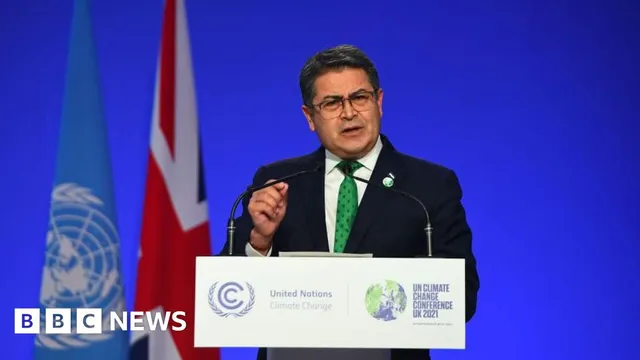
Trump plans full pardon for convicted ex-Honduran president
Trump plans full pardon for convicted ex-Honduran president
- In March 2024, Juan Orlando Hernández was convicted in a U.S. court for drug trafficking and received a 45-year sentence.
- Donald Trump announced plans to pardon Hernández, claiming he was treated unfairly.
- This development comes right before significant elections in Honduras, where Trump supports candidate Nasry Asfura.
Story
In the context of ongoing political developments in Honduras, former President Juan Orlando Hernández, who served from 2014 to 2022, was convicted in March 2024 in a U.S. court of conspiring to import cocaine and related weapons offenses, resulting in a 45-year prison sentence. Donald Trump, the former U.S. president, announced via a Truth Social post that he intends to grant a 'full and complete pardon' to Hernández, claiming he had been treated 'harshly and unfairly.' This decision comes just days before the Honduran elections, where Trump expressed his support for National Party candidate Nasry 'Tito' Asfura. Trump argued that if Asfura wins, it would signal a turnaround for Honduras towards political and financial success. In his post, Trump criticized Asfura's opponents, particularly focusing on Rixi Moncada from the ruling LIBRE Party, who he described as someone idolizing Fidel Castro, and Salvador Nasralla, whom he labeled a 'borderline Communist.' The political situation in Honduras has been tense, particularly with President Xiomara Castro, who has forged ties with countries like Cuba and Venezuela since taking office. Despite these relationships, Castro has cooperated with the U.S., maintaining an extradition treaty and hosting a U.S. military base aimed at combating organized crime. The backdrop of the upcoming election, with polls indicating a tight race between Asfura, Moncada, and Nasralla, underscores Trump's involvement in the region and his focus on anti-communist sentiments alongside aiding Honduras. The implications of pardoning Hernández, who was deeply implicated in drug trafficking, raise legal and ethical questions, reflecting ongoing debates over drug policy and U.S.-Latin American relations. Hernández's conviction and Trump's proposed pardon represent the complex intersection of law, politics, and international relations, particularly in the context of U.S. interests in Central America, especially concerning drug trafficking and the influence of leftist governments.
Context
U.S. foreign policy towards Latin America has evolved significantly over the decades, shaped by a combination of historical events, economic interests, and geopolitical strategies. During the early 20th century, U.S. interventionism was characterized by the Roosevelt Corollary to the Monroe Doctrine, which justified American intervention in the affairs of Latin American countries to stabilize the region and protect U.S. interests. This period saw numerous military interventions and a pervasive influence over local politics and economies, particularly in countries like Cuba, Nicaragua, and the Dominican Republic. The U.S. aimed to contain European influence and safeguard its economic interests, often prioritizing stability over democratic governance, which paradoxically fostered resentment and anti-American sentiment throughout the region. The Cold War marked a pivotal shift in U.S. foreign policy, as the focus turned to containing communism. Latin America became a battleground for U.S.-Soviet ideological conflicts, leading to support for authoritarian regimes that opposed leftist movements, as seen in Chile, Argentina, and Guatemala. The CIA's involvement in coups and covert operations to suppress leftist governance further entrenched U.S. influence but also generated significant backlash and raised ethical questions regarding human rights and democratic sovereignty. This period highlighted the complexities of U.S. engagement in the region, as efforts to promote stability led to tragic consequences and a legacy of distrust. In the post-Cold War era, U.S. foreign policy objectives shifted towards encouraging democratic governance and economic liberalization in Latin America. Initiatives such as the North American Free Trade Agreement (NAFTA) and the subsequent push for broader free trade agreements aimed to integrate Latin American economies with the U.S. market, emphasizing economic growth and development as essential for political stability. However, this approach has faced criticism for prioritizing corporate interests over local communities and for exacerbating inequalities in certain countries. The impact of globalization, coupled with rising populism and regional integration movements, has also challenged the effectiveness of traditional U.S. policy strategies in fostering favorable political climates. As of 2025, U.S. foreign policy towards Latin America continues to adapt to new challenges, including the rise of China as a key player in the region, increasing migration crises, and ongoing issues related to drug trafficking and security. The Biden administration has hinted at a recalibration, emphasizing diplomacy, development aid, and cooperation on issues such as climate change and public health, while also addressing the root causes of migration. This shift reflects a recognition of the need for a more holistic approach that respects Latin America’s sovereignty and fosters collaborative relationships, moving away from past patterns of domination. Ultimately, the effectiveness of U.S. foreign policy will depend on its ability to adapt to the dynamic political and social landscapes of Latin America.


