

North Korea neglects military airfields as snow covers runways
North Korea neglects military airfields as snow covers runways
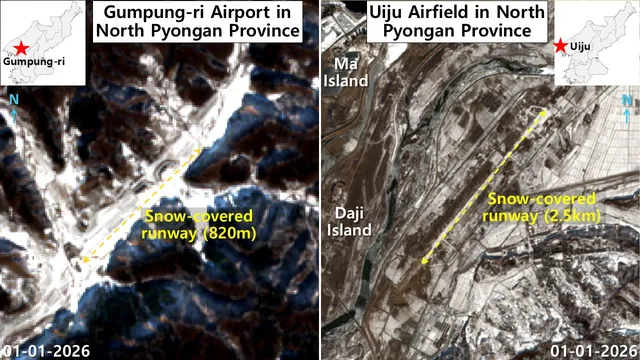
- Satellite images from late 2025 to early 2026 revealed that 12 of 21 military airports in North Korea did not clear runways of snow after significant winter storms.
- In contrast to South Korea, which employs advanced technologies to maintain operational readiness, North Korea's military infrastructure shows a prioritization issue.
- The lack of snow-clearing demonstrates a deeper problem of resource allocation and labor shortages affecting the North Korean air force's operational capabilities.
Story
North Korea's military airports and airfields have suffered notably from a failure to clear runways after heavy snowfall. An analysis of satellite imagery captured by the European Space Agency's Sentinel-2A and Sentinel-2B satellites between late 2025 and early 2026 reveals that a significant 57.1% of these runways remained blanketed in snow following severe winter conditions. This neglect contrasts sharply with the proactive maintenance observed at South Korean airports, which benefit from advanced runway heating systems and automated snow-clearing technology, ensuring operational continuity throughout winter. The lack of snow-clearing at military runways is indicative not just of maintenance neglect, but also reflects a deeper prioritization issue within the North Korean regime. The failure to allocate sufficient resources or manpower for runway maintenance points to an extensive fuel shortage that limits flight operations and military training. In South Korea, the expectation is that military and civilian runways will be cleared immediately to maintain the ability to handle aircraft operations, highlighting a significant tactical gap between the two nations. Satellite imagery showed that while civilian runways at Sunan International Airport in Pyongyang were largely cleared, the military section’s four-kilometer runway remained obstructed by snow. Similarly, at Hyesan Airfield's 1.3-kilometer runway, the snow coverage was so extensive that it rendered the runway nearly invisible. This situation poses a critical risk to the combat readiness of North Korea's air force, as such conditions severely impede the takeoff and landing capabilities of military aircraft. Additionally, insights from a source within North Korea revealed that the responsibility for airport maintenance has fallen onto schoolchildren, mobilized for seasonal duties such as weeding and snow-clearing rather than being conducted by regular military personnel. This mobilization underlines a widespread labor shortage affecting not only military operations but also basic infrastructure upkeep. Consequently, the lack of timely snow-clearing and essential maintenance highlights the North Korean regime's poor resource allocation, the low priority given to military readiness, and the genuine challenges faced in maintaining their air force capabilities in harsh winter conditions.


