

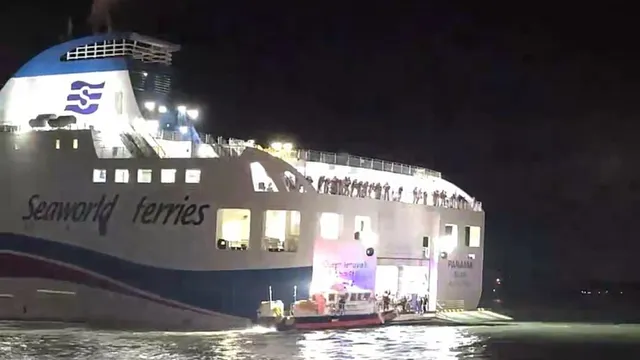
All passengers rescued after South Korean ferry runs aground
All passengers rescued after South Korean ferry runs aground
- A South Korean ferry carrying 267 people ran aground off the country's southwestern coast while en route from Jeju to Mokpo.
- The coast guard successfully rescued all passengers and crew, with some sustaining minor injuries.
- Authorities are investigating potential causes of the grounding amid concerns for passenger safety in light of past disasters.
Story
In South Korea, a ferry carrying nearly 270 people ran aground on November 18, 2025, while traveling from the southern island of Jeju to the port city of Mokpo. The vessel, the Queen Jenuvia 2, got stuck on rocks off the southwestern coast, near Jangsan Island in Sinan County, late in the evening. Rescue operations were launched shortly after the coast guard received a report of the incident, and officials noted there was no immediate risk of the ferry sinking. Fortunately, all 267 people – including 246 passengers and 21 crew members – were successfully rescued, with 27 sustaining minor injuries during the impact of the grounding. Eyewitness accounts described panic on board during the incident as a 'loud bang' was heard when the ferry struck the rocks. Passengers followed safety protocols and donned life jackets while waiting for rescue. The coast guard deployed numerous vessels and a plane as part of the immediate response and confirmed that the ferry's bow was stuck on a rocky area, but the ship remained upright. This incident quickly attracted attention due to its recalls of the Sewol ferry tragedy in 2014, where a similar occurrence tragically led to the loss of over 300 lives, pressuring authorities to ensure a swift evacuation. A preliminary investigation is ongoing, with South Korean authorities considering potential navigational mistakes or captain errors as possible causes of the grounding. Prime Minister Kim Min-seok and President Lee Jae Myung emphasized the importance of transparency during the rescue operation. Weather conditions during the incident were described as fair with light winds, which allowed for effective rescue efforts. As the situation unfolded, many passengers used social media to report their experiences, highlighting both the fear and eventual relief felt during a harrowing experience. In the aftermath, the remaining crew members stayed aboard the grounded vessel, while the majority of the rescued individuals were transported ashore in the coastal city of Mokpo. The incident serves as a stark reminder of the responsibilities of maritime safety and risk management, leading many to call for increased scrutiny of ferry operations in South Korea given the lessons learned from past maritime tragedies.
Context
The safety regulations for ferries in South Korea have gained significant attention following various maritime incidents, most notably the tragic Sewol ferry sinking in 2014. In response to these disasters, the South Korean government has implemented a series of stringent regulations aimed at enhancing the safety standards for ferry operations. These involve the introduction of more rigorous inspection protocols, mandatory training for crew members, and tighter enforcement of existing maritime laws. Such measures are designed not only to ensure the physical integrity of vessels but also to promote a culture of safety awareness within the maritime industry. One of the key reforms includes the requirement for ferries to undergo periodic safety checks and inspections conducted by authorized bodies. These inspections assess the structural integrity, lifeboat availability, fire safety equipment, and overall seaworthiness of the vessels. Additionally, technological advancements have been integrated into safety management systems, including the use of automated alerts and tracking systems for real-time monitoring of ferry operations. This proactive approach helps in identifying potential hazards before they escalate into serious incidents. Crew training has been highlighted as another critical area of focus. All ferry operators are now mandated to undergo comprehensive safety training that encompasses emergency response drills, customer evacuation procedures, and familiarization with the boat's safety equipment. Furthermore, the government has instituted strict penalties for violations of safety protocols, effectively encouraging compliance among ferry operators and crew members. Public awareness campaigns have also been launched to educate passengers about safety procedures and evacuation routes in case of emergencies, fostering a community-centered approach to maritime safety. Despite these positive developments, challenges remain in the effective enforcement of the regulations. Issues such as regulatory compliance among smaller operators and ongoing concerns related to human error on the part of crews continue to pose risks to maritime safety. The government's commitment to constant improvement and adaptation of regulations is critical to addressing these challenges. Stakeholder collaboration within the maritime industry, along with continued investment in infrastructure and technology, will be pivotal in ensuring that the South Korean ferry system evolves into one characterized by high safety standards and reduced risk of accidents.


