

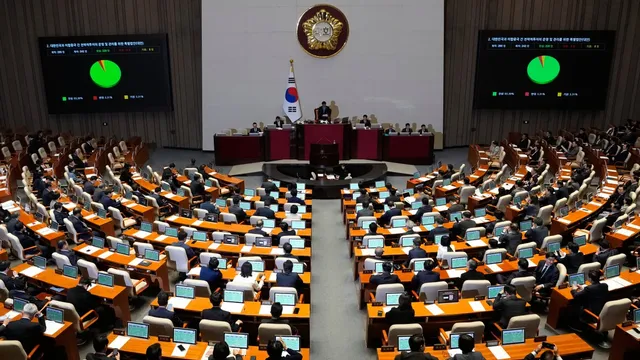
South Korean lawmakers pass law to manage massive U.S. investments
South Korean lawmakers pass law to manage massive U.S. investments
- South Korean lawmakers approved legislation to manage $350 billion in U.S. investments, fostering governmental efforts to ward off unfavorable tariffs.
- The law establishes a public corporation to oversee investment projects, aiming to align with Korean and U.S. trade mandates.
- Concerns were raised by opposition lawmakers about potential risks to local interests and economic autonomy amid rising trade tension.
Story
In March 2026, South Korean lawmakers passed a significant piece of legislation aimed at implementing a pledge for $350 billion in U.S. investments. This pledge was made the previous year to stave off trade pressures stemming from the Trump administration's tariffs. The implementation of this law is critical for South Korea, a country heavily reliant on trade, as uncertainties surrounding its economy have been heightened by aggressive protectionist measures from the United States. The situation is further complicated by geopolitical tensions arising from the U.S.-Iran conflict and ongoing trade investigations into manufacturing practices in allied nations. The law, which was signed off with a vote tally of 226 to 8, establishes a public corporation responsible for managing the proposed investments. This corporation will oversee the selection and review of projects, ensuring that the decisions align with both Korean and U.S. trade authorities. As South Korea moves forward, the government's ability to navigate these investments is vital for sustaining economic stability amidst growing international trade tensions. Resistance to the law emerged from opposition lawmakers who expressed concern regarding the economic implications and Trump's ongoing investigations into trade practices, which could impact South Korea’s export-dependent economy significantly. A member of the opposition Party articulated her frustration with the law, stating it does not provide adequate legislative power to oversee the potential investments, thereby raising alarms about protecting domestic interests. This dissent highlights the complexities and potential risks associated with foreign investment management in a volatile trade environment. In the backdrop of these legislative developments, South Korea had earlier finalized an agreement with the United States to invest $200 billion in cutting-edge industries, including semiconductors, and a further $150 billion in shipbuilding. This agreement was pivotal in obtaining a lower reciprocal tariff rate for South Korean exports. However, South Korea’s annual investment has been capped at $20 billion to help protect its foreign currency reserves, an essential buffer amid uncertain economic conditions. The passing of this law marks a critical juncture in South Korea's economic strategy as it grapples with external pressures from the U.S. and evolving geopolitical landscapes.
Context
South Korea, a nation distinctly recognized for its export-oriented economy, has developed a trade-dependent structure that is intricately woven into the fabric of its overall economic landscape. Owing to a relatively small domestic market, the country relies significantly on international trade to bolster its growth and maintain stability. Key sectors such as electronics, automobiles, and shipbuilding characterize its exporting prowess, making it one of the world’s top trading nations. In 2022, South Korea recorded a trade volume of over $1 trillion, underscoring the critical role that exports play in fueling its economic engines. This reliance on trade not only reflects South Korea's successful industrial policies but also highlights the vulnerabilities that accompany such dependence on global markets and economic partners. The trade dynamics of South Korea are notably influenced by its intricate relationships with major economies. The United States and China stand out as pivotal trade partners, with a significant share of exports directed towards these countries. This trading relationship provides ample opportunities for growth but also raises challenges, particularly in terms of trade negotiations and economic stability. For instance, the ongoing trade tensions between the U.S. and China have placed South Korea in a precarious position, necessitating strategic maneuvering to protect its economic interests while fostering robust bilateral ties. Moreover, global supply chain disruptions, exacerbated by events such as the COVID-19 pandemic, have further complicated trade routes and highlighted the potential risks inherent in Korea’s export-reliant framework. Furthermore, South Korea's economy is noticeably affected by external factors such as fluctuations in global demand, currency exchange rates, and geopolitical tensions. Sudden shifts in demand for Korean goods can have corresponding effects on domestic production and employment levels, creating an economic environment that is susceptible to external shocks. The volatility of the Korean won against other currencies can also impact the competitiveness of exports, affecting profit margins for Korean companies. In response to these challenges, the South Korean government has implemented various measures aimed at diversifying its economy and reducing dependence on a select few markets. Such initiatives include enhancing trade partnerships with emerging economies and investing in high-tech and value-added industries. In navigating the complexities of a trade-dependent economy, South Korea faces the imperative to innovate and adapt to the rapidly changing global landscape. The government's focus on fostering research and development, alongside promoting small and medium-sized enterprises, plays a pivotal role in ensuring sustained economic resilience. By investing in new technologies and green industries, South Korea aims to transition towards a more diversified economic model that minimizes risks associated with trade dependencies. The road ahead for South Korea entails balancing its reliance on trade while reinforcing domestic capabilities and exploring new markets, thus securing its position as a formidable player within the global economy.


