

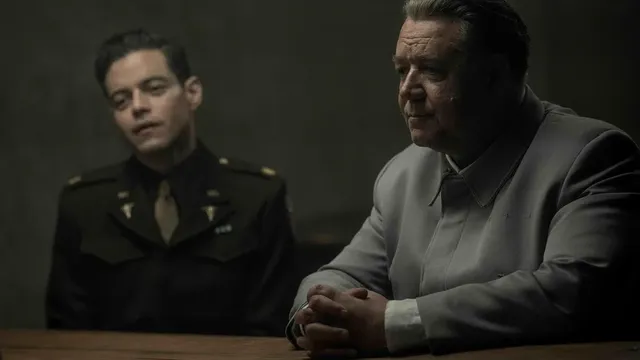
Russell Crowe portrays chilling Goring in uneven war crimes drama
Russell Crowe portrays chilling Goring in uneven war crimes drama
- The film dramatizes the legal and psychological dimensions of the Nuremberg Trials.
- Russell Crowe's portrayal of Hermann Goring highlights the complexities of Nazi leaders' justifications.
- The narrative presents a blend of courtroom drama and personal stories, but struggles with uneven execution.
Story
The Nuremberg Trials, which took place after World War II, aimed to prosecute war criminals for their actions during the Holocaust. The historical drama delves into the psychological and legal intricacies of these trials, featuring characters like Hermann Goring, portrayed by Russell Crowe, who embodies the pompous nature of Nazi leaders. The film highlights the backroom legal strategies and the political dynamics between the American and British prosecution teams. One of the film's key elements is the interviews conducted by psychiatrist Dr. Douglas Kelley, who seeks to understand how such individuals rationalized their actions. Although much of the legal proceedings were a foregone conclusion, efforts were made to present the trials as fair and just rather than acts of vengeance. The film struggles with the balance of a courtroom drama and the emotional weight of personal stories tied to the Holocaust, rendering the experience uneven but still impactful. In its portrayal of the trials, the film shows how significant historical moments can shape public perception and accountability for actions taken in the name of government. The interaction of characters reflects that despite their heinous acts, they often rationalized their actions under the guise of patriotism and duty. Goring’s chilling response about Hitler emphasizes the allure of nationalist rhetoric and the complexities of following a dictatorship that promises to restore national pride. The drama attempts to address the psychological questions surrounding ordinary men engaging in extraordinary evil, a theme that resonates well in discussions of moral responsibility and justice. However, the narrative faces critiques for its sentimentality and romantic plotlines that detract from the gravitas of the subject, providing mixed reactions on how effectively it conveys the tragedy of its themes. Overall, the film’s disjointed narrative and character portrayals offer a compelling view into a pivotal historical event, while also reminding audiences of the continuous struggle against the horrors of war and human atrocity. It raises essential questions that remain relevant today about ethics, power, and the human capacity for both evil and redemption.
Context
The Nuremberg Trials, held between 1945 and 1946, marked a significant turning point in the development of international law following World War II. The tribunal was established to prosecute prominent leaders of Nazi Germany for war crimes, crimes against humanity, and genocide, setting precedents that significantly impacted the global legal landscape. The Trials underscored the principle that individuals, including heads of state, could be held accountable for their actions under international law, countering centuries of sovereign immunity that allowed individuals to evade prosecution due to their positions. This shift paved the way for future international courts and tribunals aimed at enforcing international law and delivering justice for heinous acts committed during wartime. One of the landmark contributions of the Nuremberg Trials was the establishment and clear definition of key legal concepts that remain relevant today. The principles articulated in the prosecution's cases against the defendants, including the definitions of war crimes, crimes against peace, and crimes against humanity, provided a framework for international law. The concept of 'crimes against humanity' was especially transformative, encompassing widespread atrocities committed against civilian populations. The Trials demonstrated for the first time that such acts would not go unpunished and that sovereignty could not serve as a shield against international justice, thereby influencing the creation of later legal documents and treaties, like the Geneva Conventions. The Nuremberg Trials also catalyzed the establishment of various international institutions and legal frameworks, most notably the International Criminal Court (ICC), which was established in 2002. The establishment of the ICC reflected a commitment by the international community to uphold the rule of law globally, ensuring that individuals responsible for the most serious crimes, such as genocide and war crimes, would face justice. Additionally, the principles and procedures developed during the Nuremberg Trials influenced national legal systems and have been integrated into various legal instruments around the world, reinforcing the universality of human rights and the need for accountability. Despite its groundbreaking contributions, the impact of the Nuremberg Trials also faced criticism and challenges. Critics argue that the Trials were selective in their prosecution, as they focused primarily on leaders of the Axis powers while overlooking the actions of the Allied forces. Others have pointed out that the legal principles established were not universally accepted at the time and that many countries still resist the concept of international jurisdiction. Nevertheless, the Nuremberg Trials remain a cornerstone of modern international law, laying the groundwork for accountability and justice that continues to evolve. As the world confronts contemporary challenges such as terrorism, ethnic cleansing, and war crimes, the legacy of Nuremberg endures, reminding nations of their obligation to protect human rights and maintain the rule of law in the pursuit of global justice.


