

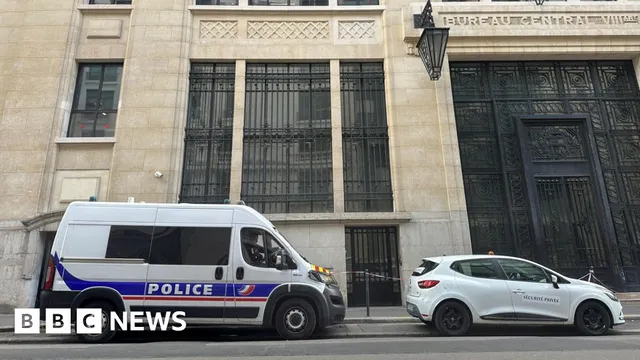
Arrest made in thwarted bombing attempt at Bank of America in Paris
Arrest made in thwarted bombing attempt at Bank of America in Paris
- French police arrested a suspect who was attempting to ignite a homemade explosive device.
- The individual claimed to have been recruited via Snapchat, raising concerns about social media's role in radicalization.
- A counterterrorism investigation is ongoing, highlighting heightened vigilance due to international threats.
Story
In Paris, France, on Saturday, March 28, 2026, local police made a significant arrest when they intercepted a suspect attempting to ignite a homemade explosive device outside a Bank of America branch. This incident unfolded around 3:30 a.m. local time on Rue de la Boétie, situated near the famous Champs-Élysées. The assailant reportedly carried a five-liter container believed to hold fuel, along with an ignition device containing approximately 1.5 pounds of explosive powder. The swift police action prevented what officials suspect could have been a severe act of terrorism. The suspect, allegedly a minor with Senegalese nationality, claimed to have been recruited through the social media platform Snapchat. This recruitment angle has raised significant alarms among security agencies about the rising trend of using social media to incite violent actions. Authorities are actively pursuing information on a second suspect who managed to escape the scene during the police intervention. The investigation has been handed over to the national anti-terrorism prosecutor’s office, which is focusing on the broader implications of this act, particularly in the context of increased threats against U.S. and Israeli-related interests in France following heightened tensions due to the ongoing conflict involving Iran. In light of this incident, Interior Minister Laurent Nuñez commended the quick response of the police, emphasizing the need for elevated vigilance in the current international landscape, particularly regarding potential threats against U.S. assets and the Jewish community. He hinted at the continuity of protection measures being enhanced since the onset of the Iran war late last month, stressing the importance of combating such emerging threats. The investigation is not solely focused on the explosive device but also on the networks that may be facilitating recruitment and training for such violent acts among youth. This incident illustrates the evolving tactics of recruitment that terrorist groups may employ, using platforms that are prevalent among younger demographics. It signals a concerning trend of incorporating modern technology into traditional methods of radicalization and recruitment. The authorities in France are not only investigating this single event but are also working to preemptively address what may arise if social media recruitment continues unchecked. As investigations proceed, the identity of the arrested suspect and their affiliations with any terrorist organizations remain a critical focus for French law enforcement.
Context
The impact of social media on radicalization has become an increasingly critical area of study in recent years, given the rapid rise of online platforms as tools for communication and information dissemination. Social media allows individuals and groups to connect over shared ideologies, often leading to the formation of echo chambers where extremist views can thrive. These platforms facilitate the spread of propaganda and misinformation, which can contribute to the radicalization process. Individuals, especially those who are isolated or feel marginalized, may be more susceptible to these online influences as they seek belonging and validation. As such, social media acts as both a catalyst and a breeding ground for extremist ideologies, making it a vital component in understanding contemporary radicalization patterns. In analyzing the role of social media in radicalization, it is essential to recognize the various mechanisms through which this influence occurs. Platforms such as Facebook, Twitter, and YouTube serve as channels for groups to share their narratives, recruit followers, and organize activities. The algorithms used by these platforms often promote content that aligns with users' pre-existing beliefs, which can further entrench extremist views. Additionally, social media provides anonymity, allowing individuals to explore and express radical ideas without immediate repercussions, thus lowering the barriers to engaging with extremist content. This accessibility is particularly concerning when it comes to vulnerable populations, including youth who may be more inclined to gravitate towards radical ideologies as they navigate their identities in a complex social landscape. Moreover, the phenomenon of online radicalization is not limited to any single ideology but spans various extremist movements, including political, religious, and social spheres. The global nature of social media amplifies this trend, as individuals can access content from across the world, thereby broadening their worldview and exposure to radical ideas. This transnational aspect of radicalization can lead to a convergence of local and global extremist narratives, making it more challenging for authorities to monitor and intervene in these processes. Furthermore, the decentralized nature of social media complicates the task of combating radicalization, as there is often no central authority governing the content shared on these platforms. In response to the challenges posed by social media in the context of radicalization, various stakeholders, including governments, tech companies, and civil society organizations, are exploring strategies to mitigate its negative impacts. Efforts to counter radicalization online have included the promotion of counter-narratives, the establishment of reporting mechanisms for extremist content, and collaborations between social media companies and law enforcement agencies. However, these initiatives face significant hurdles, including concerns around freedom of expression, privacy, and the potential for censorship. Balancing the need for security and the protection of civil liberties remains a contentious issue, highlighting the complexities of addressing radicalization in the digital age. As the landscape of social media continues to evolve, ongoing research and dialogue will be crucial in developing effective strategies to reduce the risk of radicalization.


